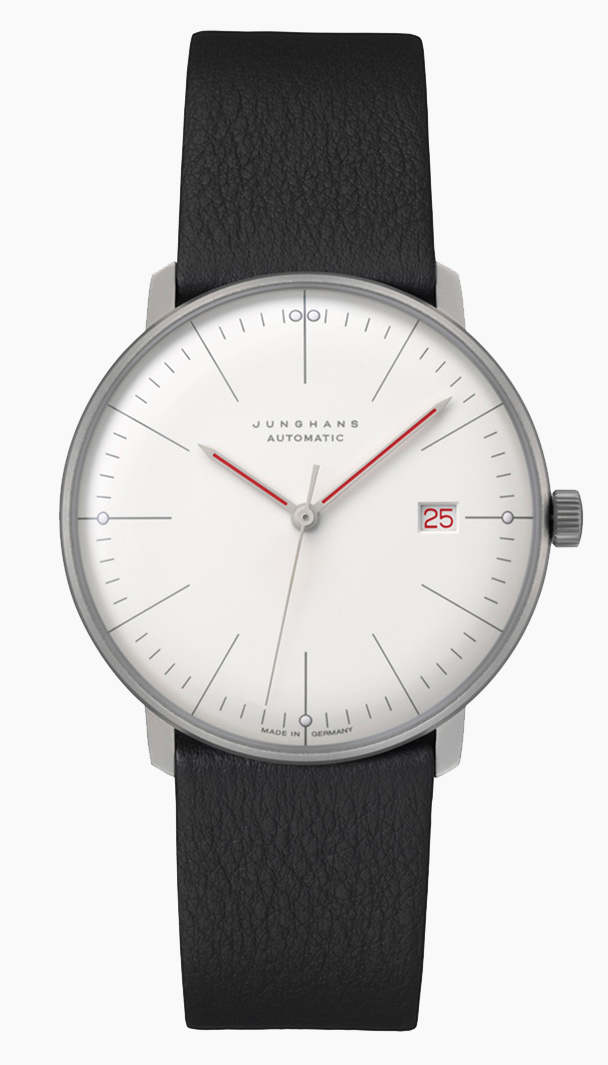
Originality matters on this reference. An original dial and hands command a significant premium. Service replacements typically trade at a 20-40% discount to original examples.
Stable over the past 90 days
Based on eBay sales, last 12 months
Pre-owned watches trade across a wide condition spectrum. These ranges are typical for the secondary market.
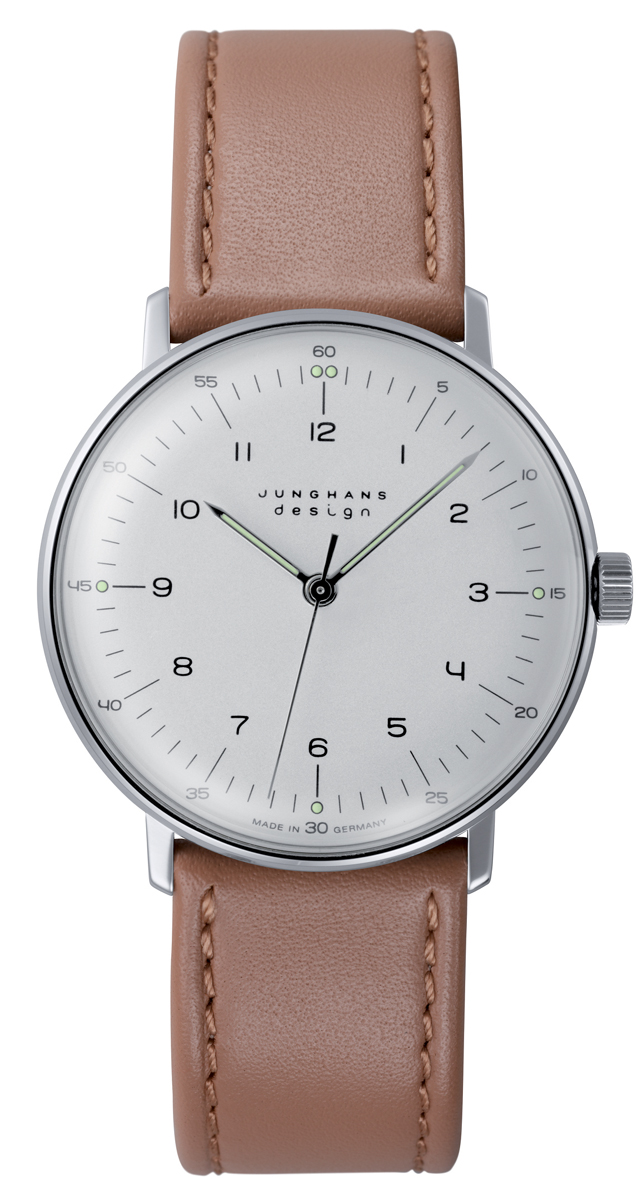
Max Bill designed this watch in 1961 applying the same logic he used on furniture and typography: remove everything that does not serve the function, then stop. The result is a dial so resolved it has barely needed revision in sixty years. If you want a Bauhaus watch and not just a watch that invokes Bauhaus, this is it.
Max Bill studied at the Bauhaus under Kandinsky and Albers before becoming one of the leading figures of Swiss concrete art and design. His collaboration with Junghans in the early 1960s produced a range of clocks and watches that applied Bauhaus principles directly to timekeeping objects. The Max Bill Automatic entered production in 1961 and has remained in continuous production since, which is a rare distinction.
Junghans updated the movement over the decades but kept the dial architecture essentially intact. The current 38mm reference with the J800.1 caliber is the closest thing to Bill's original intent that you can buy new today.
The J800.1 is a regulated ETA 2824-2, which is a solid workhorse but not a manufacture movement. Buyers expecting something proprietary will be disappointed, though accuracy is generally excellent. The domed acrylic crystal on older references scratches easily and needs periodic polishing.
Straps on earlier examples used a non-standard lug width that limits aftermarket options, so confirm the lug width before buying used. Dial printing on some units has shown minor inconsistency in the ring graduation spacing under close inspection. Prices for new examples have crept up, so the value edge over Nomos has narrowed compared to five years ago.
New examples retail in the $800 to $1,100 range depending on strap configuration and dial variant. Used examples in good condition trade for $500 to $800, occasionally less if the crystal is scratched or the bracelet is stretched. The Max Bill holds value reasonably well for a non-Swiss-movement watch, which reflects genuine collector demand rather than hype.
The J800.1 is a branded and regulated ETA 2824-2, one of the most widely serviced movements in the world. Any competent independent watchmaker can service it, and parts are readily available. Service intervals of five to seven years are typical, with costs well below what you would pay for a manufacture movement.
Community + OSINT signals haven’t landed for this reference yet. We don’t publish a rating against zero signal — the number would mean nothing. Editorial body + caliber + market value still surface above; ratings appear once the signal corpus does.
Counterfeit dials are the primary risk; color and text precision are the tell.
| Area | What to check | What is correct | Red flag |
|---|---|---|---|
| dial | Lacquer color | Specific off-white or white lacquer with tightly printed text; no yellowing | Slightly yellower or brighter than original; compare under identical lighting |
| dial | Applied index alignment | All indices precisely seated with zero tilt | Any index tilted, recessed, or lifted |
| caseback | Cal. J800.1 designation | J800.1 engraved or printed; ETA 2824-2 base with Junghans finishing | Generic ETA 2824-2 without Junghans designation; incorrect caliber installed |
The Max Bill Automatic is the most recognizable Junghans piece. The Bauhaus design language demands absolute dial restraint: no extraneous text, no date window on the no-date variant, and a printed "Max Bill" inscription at 12 that is the single most important authenticity marker.
| 1961 to present | Silver or white lacquer dial. "JUNGHANS" printed at 12, "max bill" in a smaller lowercase typeface directly below. Thin minute track around the chapter ring. Applied rectangular hour markers with no lume. Leaf-shaped or simple baton hands. |
|