GrailAtlasAn independent mechanical watch reference
Deutsch

The long-running matte-dial Explorer produced from 1963 to 1989; vintage collectors treat this as the most correct-proportioned Explorer ever made.

Uncommonmost sought#1 in familyOfficial press photos

Originality

Originality matters on this reference. An original dial and hands command a significant premium. Service replacements typically trade at a 20-40% discount to original examples.

Live pricing is coming soon. Get notified when it is available for this reference.

In-house manufacture caliber · caliber Rolex Cal. 1570: in-house automatic, 19,800bph, 44h PR, 26j; Glucydur balance, self-compensating Microstella regulator; COSC-certified · 44h power reserve · solid caseback
Small case: suits slender wrists (under 6.5 in / 16.5 cm)
36 mm case. A compact, elegant wear. Particularly at home on narrower wrists where larger cases can overhang.

Not yet rated

Community + OSINT signals haven’t landed for this reference yet. We don’t publish a rating against zero signal: the number would mean nothing. Editorial body + caliber + market value still surface above; ratings appear once the signal corpus does.

Search pre-owned listings

Chrono24
eBay (sold listings)
WatchBox

Authentication

The Explorer 1016 ran 26 years with significant dial and hand variations. Dial originality is the central authentication and value question: refinished dials are common and trade at a heavy discount.

Known issues in the market
  • Dial repainting is documented extensively on this reference; gilt dials (1962-1966) are especially targeted for artificial enhancement.
  • The long production run (1963-1989) makes serial-to-dial-generation matching an important step.
  • Case polishing has removed original surface geometry on a significant percentage of surviving examples.
AreaWhat to checkWhat is correctRed flag
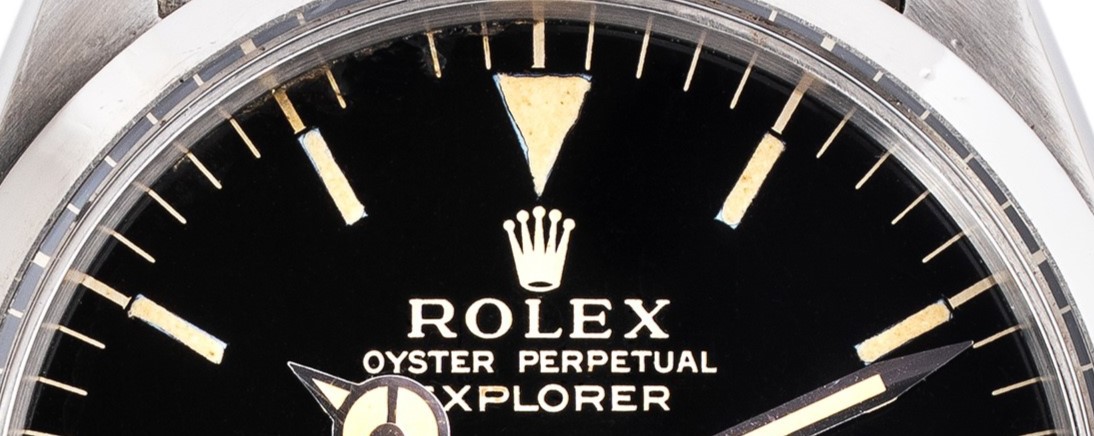
dialGilt vs. matte dial for the stated eraGilt era (approx. 1962-1966): gold-colored printing on glossy lacquer; matte era (1966+): white/silver printing on flat matte surfaceGilt printing in a case with a post-1966 serial; matte dial with no aging on a stated early-1960s example
dialTritium lume aging consistencyTritium plots at 3, 6, and 9 should show consistent cream-to-tan patina matching the dial tone; natural variation between individual plots is authenticBright white lume plots on a stated pre-1970s dial; all plots identical in color (suggesting replacement)
handsMercedes hour hand lume generation and colorLume color in the Mercedes hand cavity should match the dial plot aging tone; era-correct hands have correct lume material for the production yearSuper-LumiNova (white) lume in a stated 1960s or 1970s example; lume color mismatch between hands and dial
caseBrushed lug top surfacesLug tops are brushed with visible directional grain; the transition to polished lug sides is crispMirror-polished lug tops indicating case refinishing that has removed original brushing
casebackReference and serial placementReference 1016 between lugs at 12; serial between lugs at 6; solid caseback with correct EXPLORER engraving at centerSerial number outside the 1963-1989 production window; caseback engraving in incorrect typeface for the era
movementCal. 1560 or 1570 with no quickset dateThe 1016 is a no-date reference; no quickset date function should be present; bidirectional rotor; runs at 19,800bphAny quickset date function (means the movement has been replaced); unidirectional or loose rotor
Common legitimate replacements
  • Crystal replacement is very common on examples with decades of use; acrylic domes were original on many early examples.
  • Crown replacement is documented; confirm correct profile for the production era.
  • Bracelet replacement with Oyster or aftermarket bracelets is common; original bracelets are preferred by collectors.
Expert resources: Rolex Forums vintage subforum has 1016-specific authentication threads with serial-to-dial generation tables. Phillips and Christie's auction archives provide authenticated comparison examples. For significant purchases, forensic movement dating by a specialist watchmaker is advisable.

Authentication guide

Last reviewed June 2026

The Explorer 1016 ran from 1963 to 1989 -- a 26-year production run with significant dial and hand variations. Dial originality is the central authentication and value question. Outright fakes are less common than non-original parts or refinished dials.
Known reproduction risks

toggle
MEDIUM

Correct-case 1016 examples with non-original dials refinished or replaced to appear more desirable (gilt dial swaps into matte-era cases).

  • Gilt dial text in a case with a serial number from the matte-dial production period
  • Dial aging inconsistent with the case and movement serial range
  • Gilt printing that appears too fresh or uniform without the characteristic lacquer craze
LOW

Outright replica 1016 watches are less common than mixed-parts examples given the specialist knowledge required to replicate correctly.

  • Case lug geometry that does not match known 1016 production -- the 1016 has specific lug transitions
  • Movement caliber that is incorrect for the stated serial range

Dial variants by era

toggle
EraDescriptionIdentifiers
1963 to 1966Gilt dial with gold printing and tritium lume. The most desirable variant for collectors.
  • Gold "Explorer" and "Rolex Oyster Perpetual" text on glossy black lacquer
  • Lume plots in tritium at 3, 6, and 9; no 12 lume bar (replaced by applied "XII" on some examples)
  • "Swiss" only at 6 o'clock with no "Made" suffix
  • Gilt applied Arabic numerals at 3, 6, 9 in gold
  • Lacquer craze visible under 10x magnification on genuine aged examples
1966 to 1976Matte black dial transitioning to white silver printing. SWISS MADE added to dial foot.
  • White/silver "Explorer" and "Rolex Oyster Perpetual" text (not gold)
  • Matte dial surface without lacquer gloss
  • "Swiss Made" at 6 o'clock on later examples
  • Tritium plots (T Swiss T designation at very bottom of dial on some examples)
1976 to 1989Later matte dials with updated printing and Super-LumiNova transition at the end of the run.
  • "T Swiss T" radiation designation at the very bottom of the dial on tritium examples
  • Later examples approaching 1989 may show early Super-LumiNova in white rather than tritium cream
  • Consistent matte texture with high-quality text registration throughout this period

Service part flags

toggle
Dial

Original: Gilt or matte black depending on era, with natural aging consistent with production year. Original dials are the single largest value driver on the 1016.

Replacement tells
  • Uniform, unaged appearance on a stated early-1960s dial -- lacquer and lume age distinctively
  • Text font that does not match the production period (gilt era fonts differ from matte era)
  • Repainted text visible as slight change in surface texture at text edges under 10x
  • Lume plots that glow white and bright on a stated pre-1970 example (tritium never glows white)
Hands

Original: Mercedes hour hand and pencil seconds hand. Lume color should match the dial plot aging. Later examples have a pointed Mercede-star center.

Replacement tells
  • Service hands with Super-LumiNova (white) lume on a stated 1960s example
  • Hand geometry inconsistent with the production era -- early vs. late 1016 hands have subtle profile differences
  • Lume color mismatch between hands and dial plots
Case

Original: Polished case sides and brushed lug tops. The 1016 used a fixed lug configuration throughout its run. Cases that retain original surface geometry are preferred.

Replacement tells
  • Over-polished lugs that have lost the original corner sharpness
  • Uniformly polished case (all surfaces) removing the brushed lug top distinction
  • Lug hole presence or absence inconsistent with the stated serial-range era

Case back markings

toggle
1963 to 1989
  • Solid caseback throughout the run
  • ROLEX OYSTER PERPETUAL on outer ring
  • EXPLORER engraved at center
  • Reference 1016 stamped between lugs at 12
  • Serial between lugs at 6
  • Earlier examples have shallower caseback engravings than later examples in the run

Movement tells

toggle
  • The 1016 used Cal. 1560 (early), Cal. 1570 (mid-run), and Cal. 1570 with upgrades (late run). All run at 19,800bph.
  • The 1570 is a highly reliable automatic movement that holds accuracy well after proper service. Rate drift of more than 20 seconds per day without recent service is a sign of worn pallets.
  • Check that the quickset date is absent -- the 1016 is a no-date reference. Any quickset function means the movement has been swapped.
  • The rotor should be bidirectional. A unidirectional or loose rotor suggests worn bearings.
  • Cal. 1560 can be identified by its 17-jewel count vs. the 26-jewel 1570. Both are correct for this reference depending on production year.
Sources: Rolex Forums -- Vintage Explorer authentication threads; The Watch Quote -- Explorer reference guide; Phillips Watches -- authenticated 1016 auction lot notes.

You might also like

Rolex
Explorer
Ref. 124270
Rolex Explorer II (Polar) Ref. 16570, white dial, steel case
Rolex
Explorer
Ref. 16570
Rolex Explorer II (Modern 42mm) Ref. 226570, white dial, steel case
Rolex
Explorer
Ref. 226570
Rolex Datejust Perpetual (Vintage Steel) Ref. 1601, champagne dial, steel case
Rolex
Datejust
Ref. 1601
Rolex
Cosmograph Daytona
Ref. 6263

Buying guidance

← Back to Grail Atlas