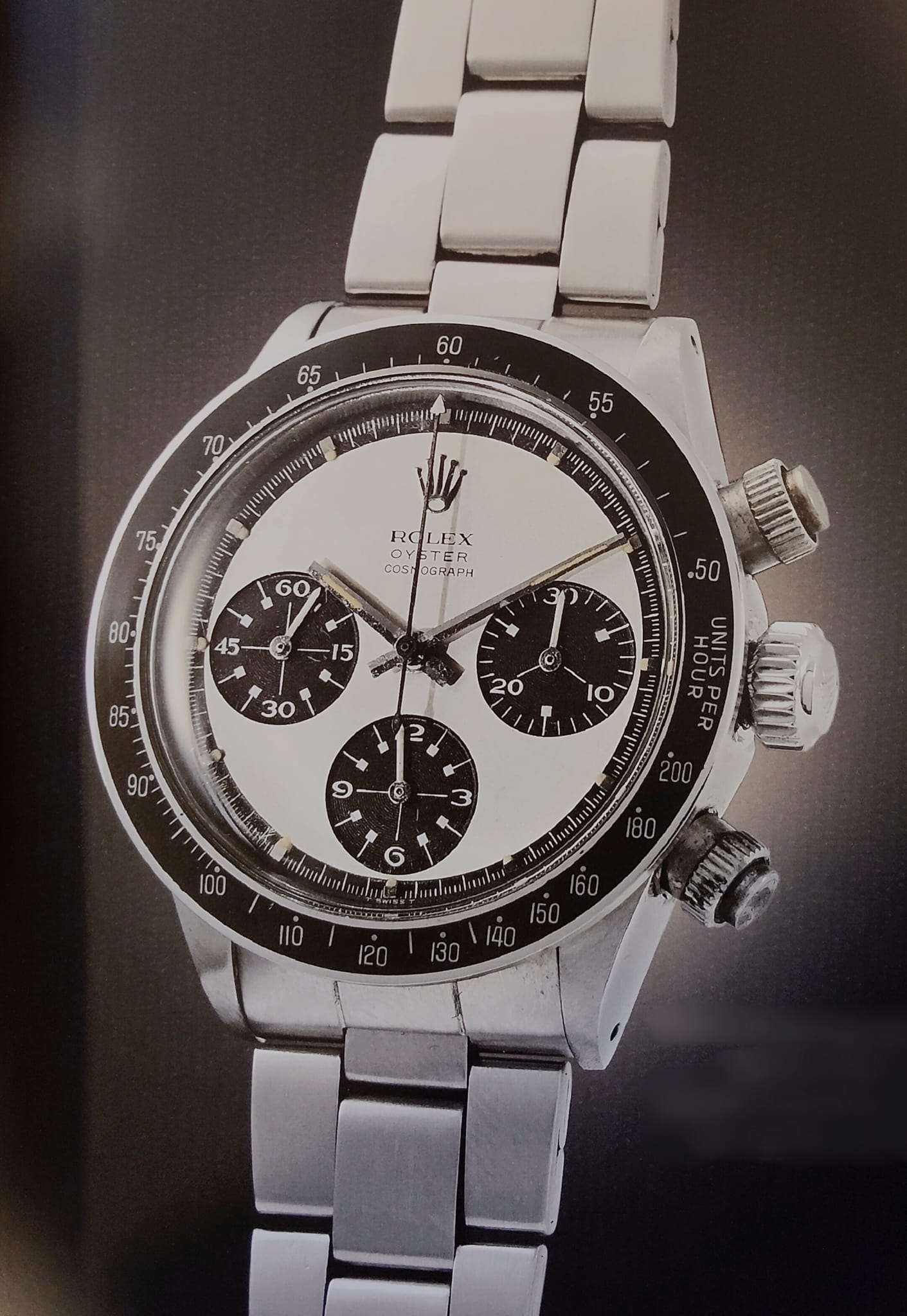
The manual-wind pre-Zenith Daytona; Paul Newman exotic-dial examples within this reference number are among the most valuable wristwatches in any auction.
Originality matters on this reference. An original dial and hands command a significant premium. Service replacements typically trade at a 20-40% discount to original examples.
The Paul Newman dial is the most recognized premium dial variant in vintage watch collecting. Demand far exceeds supply and auction records are set regularly. Even a distressed example commands multiples of a standard-dial 6263.
The standard 6263 without the exotic dial is still a serious vintage piece. It is far more attainable than the Newman variant while retaining the hand-wind Cal. 727/722 movement and the period-correct case.
Live pricing is coming soon. Get notified when it is available for this reference.
The 6263 is the canonical manual-wind Daytona, produced 1971 through 1988, 37mm steel case, screw-down chronograph pushers, black acrylic bezel, and the Valjoux 727 caliber (a higher-beat variant of the Valjoux 72, 21,600 vph instead of 18,000). It is the reference that defined the pre-Zenith vintage Daytona market and the platform underneath the most-collected exotic-dial 'Paul Newman' examples.
The 6263 replaced the metal-bezel 6262 in 1971 and ran alongside the steel-bezel 6265, both shared the case, caliber, and dial architecture, differing only in the bezel construction. The Valjoux 727 was a Rolex-specified faster-beat version of the Valjoux 72 column-wheel chronograph; it is a common point of confusion in published references where the two caliber numbers are used interchangeably. Dial variants are the collector ladder: two-line 'Daytona' dials, four-line dials with depth rating, sigma-dial (the Greek sigma at six o'clock indicating gold-applied indices), 'Big Red' (the larger 'DAYTONA' text above the chronograph register), and the exotic 'Paul Newman' dials with art-deco subregisters.
Steel cases dominate production; yellow-gold (6263/8) and white-gold variants exist in much smaller numbers.
Common things to check: dial originality (the most service-replaced family in vintage Rolex, verify the printing under loupe, particularly the sub-register fonts and the depth-rating line spacing); bezel insert (the black acrylic bezel scratches and is commonly replaced, original-edge bezels carry a real premium); pushers (the screw-down pusher hardware should engage cleanly; worn threads compromise water resistance and are a service item); case (over-polishing rounds the lug chamfer, irreversible and a substantial value hit); the caliber 727 vs caliber 72 distinction (verify the movement number against published production tables); 'Paul Newman' exotic-dial examples are the most-counterfeited vintage Rolex and require provenance research that goes beyond the watch itself, service records, original sales paperwork, and ideally an extract from the Rolex archive. A presented 'Paul Newman' without a documented chain of ownership should be treated with skepticism, regardless of how clean the watch looks.
Standard black-dial and sigma-dial 6263s in honest, full-set condition trade in the mid-five-figures to low-six-figures depending on dial generation and provenance. White-dial 'Big Red' examples carry a premium; exotic-dial 'Paul Newman' variants trade in seven figures at the top end and are functionally a separate market. The vintage Daytona market has been firming steadily for two decades; clean original examples have outperformed nearly every other vintage Rolex reference over that horizon.
Provenance, original paperwork, service history, single-owner chain of custody, is the largest single price discriminator on any given example.
Valjoux 727 service is performed by Rolex's vintage service program and by competent independents who specialize in vintage Rolex chronographs. Rolex still supports the caliber, but parts availability is increasingly tight; an independent watchmaker with a stock of vintage Valjoux 72/727 parts is often the more practical service path. Service intervals 5-7 years are typical; the column-wheel chronograph mechanism is the failure point, a chronograph that resets crisply on all three subdials is healthy.
Community + OSINT signals haven’t landed for this reference yet. We don’t publish a rating against zero signal — the number would mean nothing. Editorial body + caliber + market value still surface above; ratings appear once the signal corpus does.
Cal. 727 (Valjoux 72 base) signed correctly under the caseback and an untouched black acrylic bezel insert authenticate the vintage 6263
| Area | What to check | What is correct | Red flag |
|---|---|---|---|
| dial | Dial authenticity including Paul Newman and panda variants | Printed sub-register chapter rings on Paul Newman variants; correct font for "Daytona" and "Rolex"; applied indexes with correct luminous material for era (tritium on vintage); sub-dial print consistent with documented variant | Sub-register chapter rings added to a standard dial (conversion); dial text inconsistent with documented Daytona font; luminous material inconsistent with production era; added "Paul Newman" markings on a plain dial |
| case | Black acrylic bezel insert and pump pushers | Black acrylic (plastic) tachymeter bezel insert; pump pushers at 2 and 4 o'clock; correct case diameter (37mm); Oyster case without crown guards; "Rolex Oyster" on solid lugs |
The 6263 is the screw-pusher manual-wind Daytona powered by Valjoux 727, produced from 1969 to 1988. It is historically the most counterfeited Rolex reference, with genuine "Paul Newman" dial examples regularly exceeding $500,000 at auction.
Sigma dials are not a separate look but a quality marker: the Greek letter confirmed solid gold markers when a buyer could not inspect directly. They appear across various vintage Rolex references and add a modest premium in the collector market.
A recently-serviced 6263 with paperwork from a known vintage-Rolex watchmaker is worth real money on top.
| Metal or ceramic bezel insert (post-vintage replacement); screw pushers instead of pump type; case with crown guards; re-case from a different Daytona generation |
| movement | Cal. 727 (Valjoux 72 base) | "Rolex Cal. 727" on movement; Valjoux 72 base architecture; column wheel chronograph; manual-wind (no rotor); "Swiss Made" and correct Rolex movement finishing | Rotor present (Cal. 727 is manual-wind); non-Rolex movement signing; Cal. 4030 (later quartz or El Primero-based Daytona); column wheel missing |
Artificial "tropical" dials created by chemically treating or heat-treating standard black dials to produce a brown color shift.