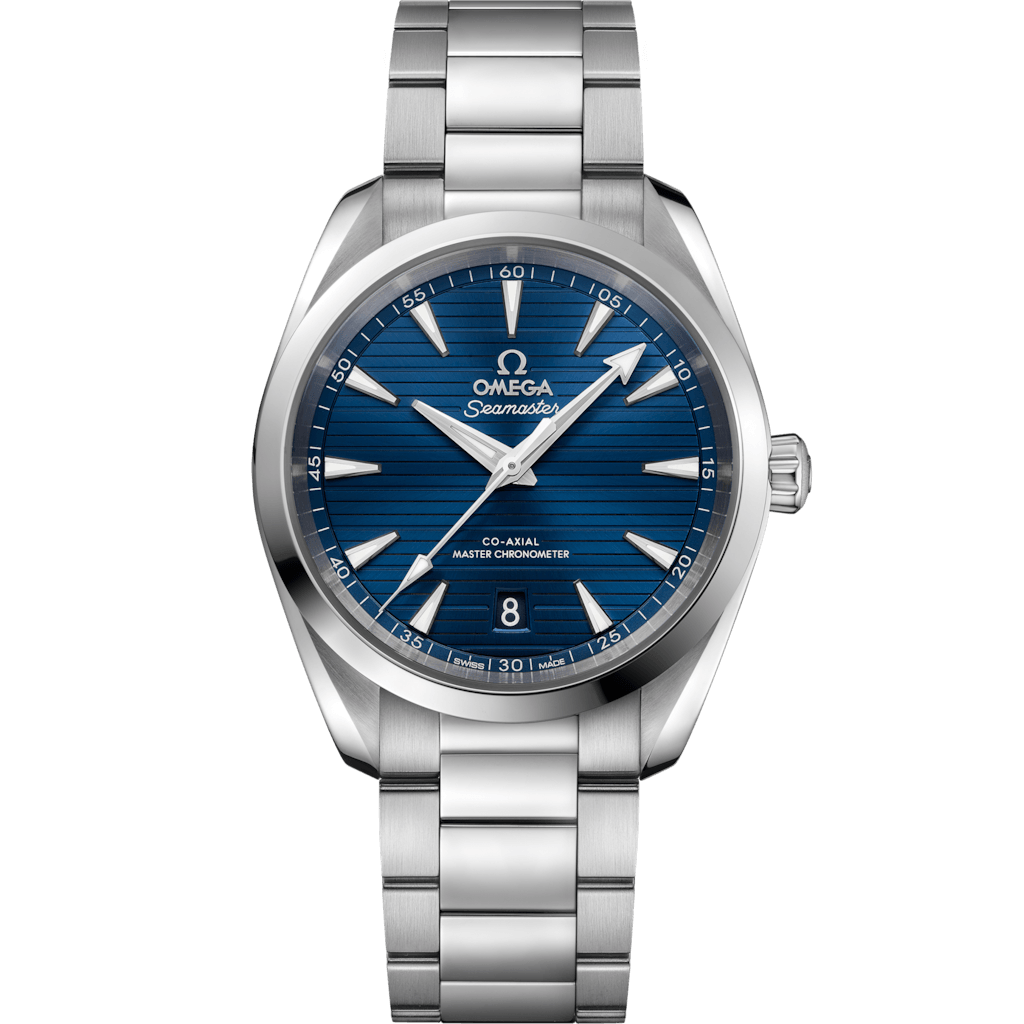
The Aqua Terra 41 is Omega's workhorse sports-dress watch: polished enough for a suit, robust enough for everyday wear, and backed by the best antimagnetic movement the brand has ever put in a steel sports case. The 15,000-gauss resistance is not a marketing footnote; it solves a real problem for anyone who works near electronics or carries a phone all day. At used prices, you get a COSC-plus-certified Master Chronometer movement for less than most microbrands charge for an ETA.
What it is
Omega introduced the Aqua Terra line in 2002, and the 41mm case arrived as the size expanded through the mid-2000s. The reference 220.10.41.21.03.001 specifically marks the 2017 introduction of the Co-Axial Master Chronometer caliber 8900, which replaced the earlier 8500/8507 family and added METAS certification to the existing COSC rating. The teak vertical-stripe dial pattern is a design constant across generations, meant to evoke teak wood decking on a sailboat; the execution is subtle in person, less busy than photos suggest.
Omega has offered this case in blue, green, grey, silver, and black dials across the current generation, and both bracelet and rubber strap configurations ship from the factory at the same reference. A no-date sibling (220.10.41.21.01.001) exists for collectors who find the date wheel visually distracting at 3 o'clock.
Buying notes
The bracelet clasp on pre-2020 examples has a reputation for loosening over time; push the deployment open and closed several times and check that the butterfly mechanism seats firmly without play. Inspect the case middle for deep scratches around the lugs, where polishing wheels often dig in and round off the edges, which are difficult to restore properly. The 8900 movement has a transparent caseback, so tilt it in good light and look for rotor bearing wobble or debris on the dial side; the Master Chronometer certification means nothing if the movement has been opened and reassembled by an unqualified watchmaker.
Confirm the crown screws down smoothly without resistance, as cross-threading is common on examples that have been pressure-tested multiple times. Finally, ask for service history; the 8900 does not need frequent service, but a watch represented as unworn with 50,000+ power reserve cycles on the rotor is a red flag.
Market read
The current generation Aqua Terra 41 sits around $3,500 to $4,200 used in steel on bracelet depending on condition and papers; grey-market new examples often undercut Omega ADs by 15 to 20 percent. Blue dial commands a consistent 5 to 10 percent premium over silver or grey because it photographs well and has the broadest resale appeal. The no-date variant is harder to find and trades at a slight premium among collectors who specifically want it, though the broader market does not reward it reliably.
Prices have been stable, not climbing; this is a buy-it-to-wear-it watch, not a speculation vehicle.
Service expectations
The caliber 8900 carries a recommended service interval of 10 years, longer than Omega's older movements, and Omega prices a full service for this caliber at roughly $600 to $800 through an authorized service center as of 2025. Independent watchmakers familiar with Co-Axial escapements will run $400 to $600, but confirm they have the specific tooling; the escapement geometry is unforgiving if adjusted incorrectly. Budget for gasket replacement if the watch has seen regular water exposure, even though 150m water resistance is generous for daily use.
Editorial copy is AI-drafted from primary sources and reviewed by Grail Atlas before publication. Where the text is uncertain about a fact, it says so. Email
corrections@grailatlas.com if something reads wrong. Signals on this page (community, OSINT) are clearly separated from the editorial sections.