GrailAtlasAn independent mechanical watch reference
Español
Rare#3 in familyOfficial press photos

Originality

Originality matters on this reference. An original dial and hands command a significant premium. Service replacements typically trade at a 20-40% discount to original examples.

Live pricing is coming soon. Get notified when it is available for this reference.

In-house manufacture caliber · caliber Rolex Cal. 1556: in-house automatic, 18,000bph, 44h PR, 25j; used in Day-Date 1803 from 1970s; quickset date predecessor; Rolex gilt movement era · 44h power reserve
Small case: suits slender wrists (under 6.5 in / 16.5 cm)
36 mm case. A compact, elegant wear. Particularly at home on narrower wrists where larger cases can overhang.

Not yet rated

Community + OSINT signals haven’t landed for this reference yet. We don’t publish a rating against zero signal: the number would mean nothing. Editorial body + caliber + market value still surface above; ratings appear once the signal corpus does.

Search pre-owned listings

Chrono24
eBay (sold listings)
WatchBox

Authentication

Dial originality is everything on vintage 1803 references; any dial that looks fresh on a 50-year-old case is a replacement.

Known issues in the market
  • Vintage 1803 dials must show aging appropriate to a 50+ year old watch; uniformly fresh dials are replacements.
  • The 1803 reference spans many precious metal and dial configurations; verify all components are consistent with the same production period.
AreaWhat to checkWhat is correctRed flag
dialDial aging consistencyLacquer aging darker at lug areas and around applied indices; aging appropriate to stated production yearUniformly fresh dial surface on a watch stated to be from the 1960s-70s; chemically treated aging is uniform, not organic
casebackCal. 1556 movementCal. 1556 or period-correct variant visible; movement bridges show aging consistent with a 50+ year old service historyModern caliber architecture; service parts that are clearly newer than the case vintage
caseCase metal consistency with documented configurationPrecious metal case (yellow gold, white gold, or platinum) consistent across all case componentsColor mismatch between bezel and case suggesting metal replacement; evidence of re-polishing removing original case lines
Common legitimate replacements
  • Vintage Rolex Day-Date dials are among the most commonly replaced components; specialist authentication is required.
  • President bracelets on vintage 1803 references are often replacement modern versions; verify period-correct clasp style.
Expert resources: Rolex vintage Day-Date 1803 collector documentation. Antiquorum and Phillips auction records for 1803 dial variants.

Authentication guide

Last reviewed June 2026

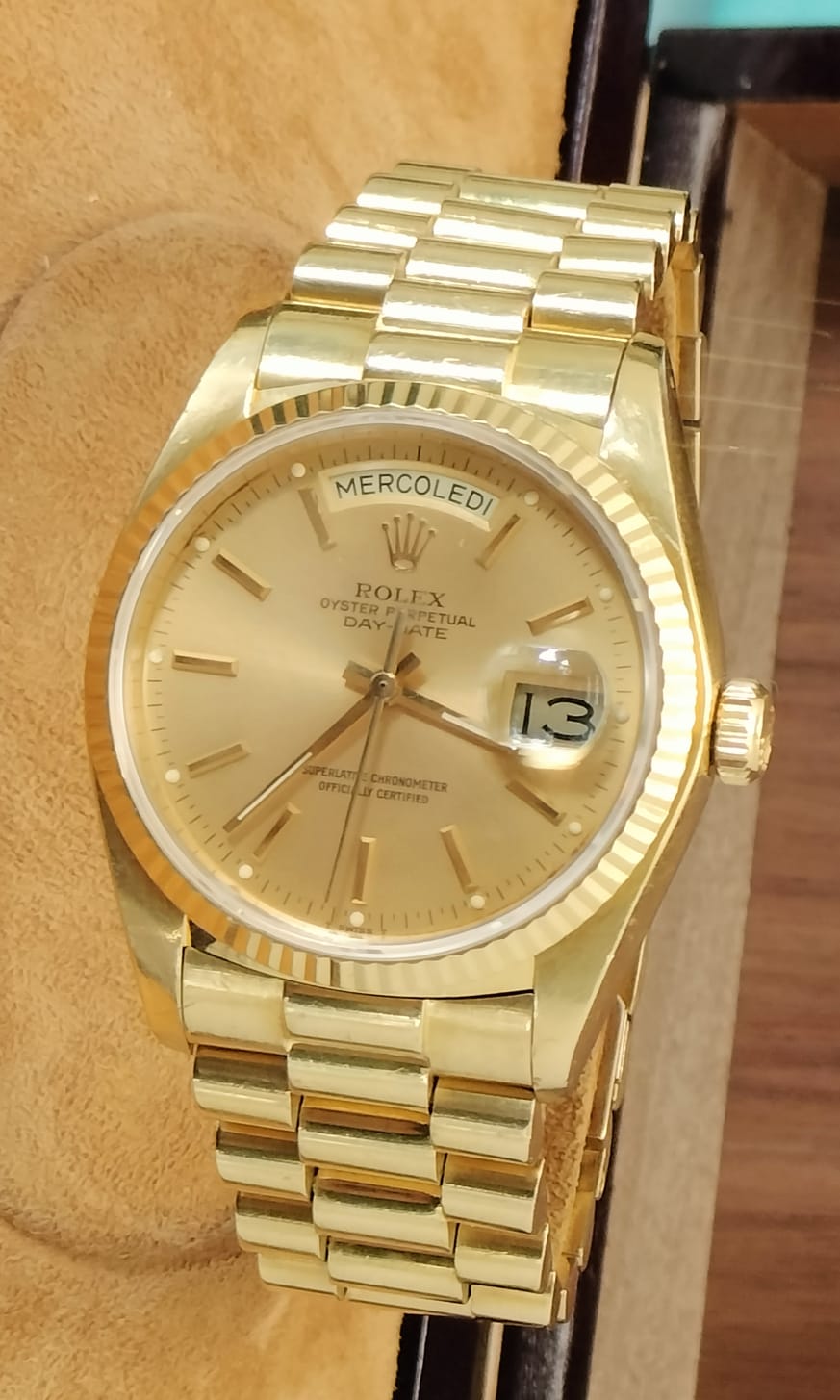
The 1803 ran from 1956 to 1977 in solid gold only -- yellow or white gold -- on Cal. 1556 (early manual-wind production) and later Cal. 1564 (automatic). No steel version was ever produced. It offered the widest exotic dial range in the Rolex catalog. Primary risks are condition misrepresentation on precious stone dials and gold case over-polishing rather than outright fakes.

Known reproduction risks

toggle
MEDIUM

Outright fakes in solid gold are rare due to material cost. The primary risks are misrepresented dial provenance (a standard dial sold as exotic, or an exotic dial from a different reference), and condition misrepresentation on precious stone dials.

  • Exotic stone dial with condition described as excellent but showing tool marks or edge chips under loupe
  • Stone dial color or pattern that does not match documented factory options for the 1803
  • Exotic dial from a different Day-Date reference mounted in a 1803 case (aperture positions and size may be subtly different)
  • Standard dial with aftermarket stone-look surface treatment -- check stone texture authenticity under 10x loupe

Condition misrepresentation on stone dials is pervasive in the secondary market. A turquoise or coral dial described as "excellent" should be scrutinized under magnification for chips, repairs, and edge issues before purchase. The premium on genuine pristine stone dials is significant and fraud risk follows accordingly.

LOW

Full replica 1803 in solid gold is cost-prohibitive for fakers. Gold-plated replicas are occasionally encountered but fail immediately on weight and wear characteristics.

  • Case weight noticeably lighter than a genuine solid gold 1803 (gold-plate over steel or brass is significantly lighter)
  • Plating wear visible at lug contact points or caseback edges
  • Case gold color with green or pale tint inconsistent with 18k yellow gold

Dial variants by era

toggle
EraDescriptionIdentifiers
1956 to ~1967 (gilt)Gilt dial era with gold printing on glossy lacquer. Day and date windows with matching printed displays. The most desirable configuration for vintage collectors.
  • Gold printing on glossy black or champagne lacquer
  • Day aperture at 12 o'clock and date at 3 o'clock with matching gold text
  • Applied gold baton or pyramid markers
  • Tritium lume aging to cream or amber consistent with early production period
  • Lacquer craze under 10x magnification on genuine aged examples
~1967 to 1977 (matte and exotic)Matte standard and exotic dial period. The 1803 was offered with a remarkable range of rare materials, including meteorite, coral, turquoise, onyx, lapis lazuli, jade, tiger eye, and various other stone and material dials.
  • Matte standard dials in silver, champagne, or other standard colors
  • Exotic stone dials: natural material with characteristic patterns (meteorite Widmanstatten pattern, coral texture, turquoise matrix)
  • Factory stone dials have precise edge finishing and consistent thickness across the dial surface
  • Day and date apertures cut precisely through the stone material without chipping or irregular edges
  • Applied gold hour markers consistent with the case metal color

Service part flags

toggle
Case

Original: Solid gold case throughout -- 18k yellow or white gold only. The 1803 was not produced in rose or pink gold; Everose is a Rolex proprietary alloy introduced after the 1803 production run ended. Solid gold is significantly heavier than gold-plated or gold-filled cases of similar size. The 1803 case has sharp lug edges and flat chamfer planes as manufactured; gold is a soft metal and polishing destroys the lug geometry quickly.

Replacement tells
  • Lugs with rounded corners where sharp chamfer planes should be -- indicates polishing
  • Case sides that show polishing striations rather than the factory brushed-to-polished distinction
  • Weight significantly lighter than expected for a solid gold case of this size -- a 36mm solid gold case is noticeably heavy
  • Gold color inconsistency across different case sections (suggesting repair or replacement of individual case parts)
President bracelet

Original: The "President" bracelet is standard for the 1803 -- semi-circular three-link construction in solid gold matching the case metal. The clasp is a concealed fold-over in matching gold. Oyster bracelet on the 1803 is documented but rare, and commands a substantial premium. The President bracelet is exclusive to the Day-Date across the entire Rolex catalog. No other production Rolex reference uses this bracelet from the factory. A claimed Day-Date on an Oyster or Jubilee bracelet without documentation of an original-owner swap has had the bracelet changed.

Replacement tells
  • Bracelet gold tone that does not match the case gold precisely (different karat, different alloy tint)
  • Clasp inner face stampings that do not match the bracelet reference correct for 1803 production pairings
  • President bracelet links that show excessive play relative to each other (stretched)
  • Aftermarket or non-Rolex bracelet mounted in place of the original
  • Oyster or Jubilee bracelet on a 1803 without credible documentation -- while some original owners did request Oyster bracelets, the absence of original papers confirming this makes the configuration worth investigating
Crown

Original: Twinlock winding crown in solid gold matching the case. The crown is specific to the 1803 case tube depth. Earlier examples in the production run use a period-correct stem length.

Replacement tells
  • Crown in a different gold tone than the case
  • Steel crown on a solid gold case (material substitution)
  • Crown that does not screw down fully or seats with incorrect resistance
  • Crown size inconsistent with the 1803 case tube
Dial (exotic stone)

Original: Factory exotic stone dials are cut and fitted by Rolex to tight tolerances. The stone surface is level with or just below the applied markers. Day and date apertures are cleanly cut through the stone. Edge finishing where the stone meets the chapter ring is clean and even.

Replacement tells
  • Stone edge at the chapter ring junction that is chipped, uneven, or shows repair material
  • Stone thickness that is inconsistent across the dial surface -- factory stones are flat
  • Day or date aperture cuts that are not clean or that show cracking at the aperture edges
  • Stone dial from a different reference period or model mounted in a 1803 case (misrepresentation of provenance)

Case back markings

toggle
1956 to 1977
  • Plain caseback in matching solid gold -- no engravings on the outer face
  • ROLEX OYSTER PERPETUAL DAY-DATE on the inner caseback face
  • Reference 1803 stamped between lugs at 12 o'clock
  • Serial number stamped between lugs at 6 o'clock
  • The caseback weight is noticeable -- solid gold is substantially denser than steel and the case back alone has perceptible heft
  • No plating wear or base metal exposure anywhere on the case (plating wears at edges; solid gold does not)

Movement tells

toggle
  • Early 1803 examples (approximately 1956 to 1965) use Cal. 1556, a manually wound caliber with day and date display. Later production switched to an automatic movement, most commonly cited as Cal. 1564 (Rolex literature also references Cal. 1565 for certain configurations; the exact caliber varies by year). A manually wound movement in a watch with a serial number dated after approximately 1965 warrants investigation.
  • Neither Cal. 1556 nor Cal. 1564/1565 has a quickset date or quickset day. The day display advances by cycling through the hours; the date advances similarly. Any quickset mechanism indicates a movement swap.
  • For automatic examples: listen for the rotor. A well-functioning automatic Cal. 1564/1565 has an audible bidirectional winding rotor. Silence where a rotor should be present suggests a movement swap to a manual-wind caliber.
  • Both caliber generations run at 19,800bph. A movement beating at 28,800bph in a 1803 case is incorrect for the period.
  • Solid gold cases are excellent insulators. The movement temperature equilibrates more slowly in a gold case than in steel. Movement function may vary slightly in the first minutes after being picked up from cold storage.
  • A correctly serviced 1556 or 1564 holds rate to within +/- 15 seconds per day. Significant rate variation suggests worn escapement components or a mainspring that has lost set.
Sources: Rolex Forums -- Vintage Day-Date authentication threads; Phillips Watches -- Day-Date auction archives and specialist notes; John Goldberger -- Rolex Day-Date reference documentation (collector standard).

You might also like

Rolex Day-Date 40 Ref. 228238, champagne dial, gold-yellow case
Rolex
Day-Date
Ref. 228238
Rolex Day-Date 36 Ref. 128238, champagne dial, gold-yellow case
Rolex
Day-Date
Ref. 128238
Rolex Datejust Ref. 16234, black dial, steel case
Rolex
Datejust
Ref. 16234
Junghans Max Bill Automatic Ref. 027/3501.04, silver dial, steel case
Junghans
Max Bill
Ref. 027/3501.04
Rolex Datejust Perpetual (Vintage Steel) Ref. 1601, champagne dial, steel case
Rolex
Datejust
Ref. 1601
Omega
Constellation
Ref. 168.005

Buying guidance

← Back to Grail Atlas