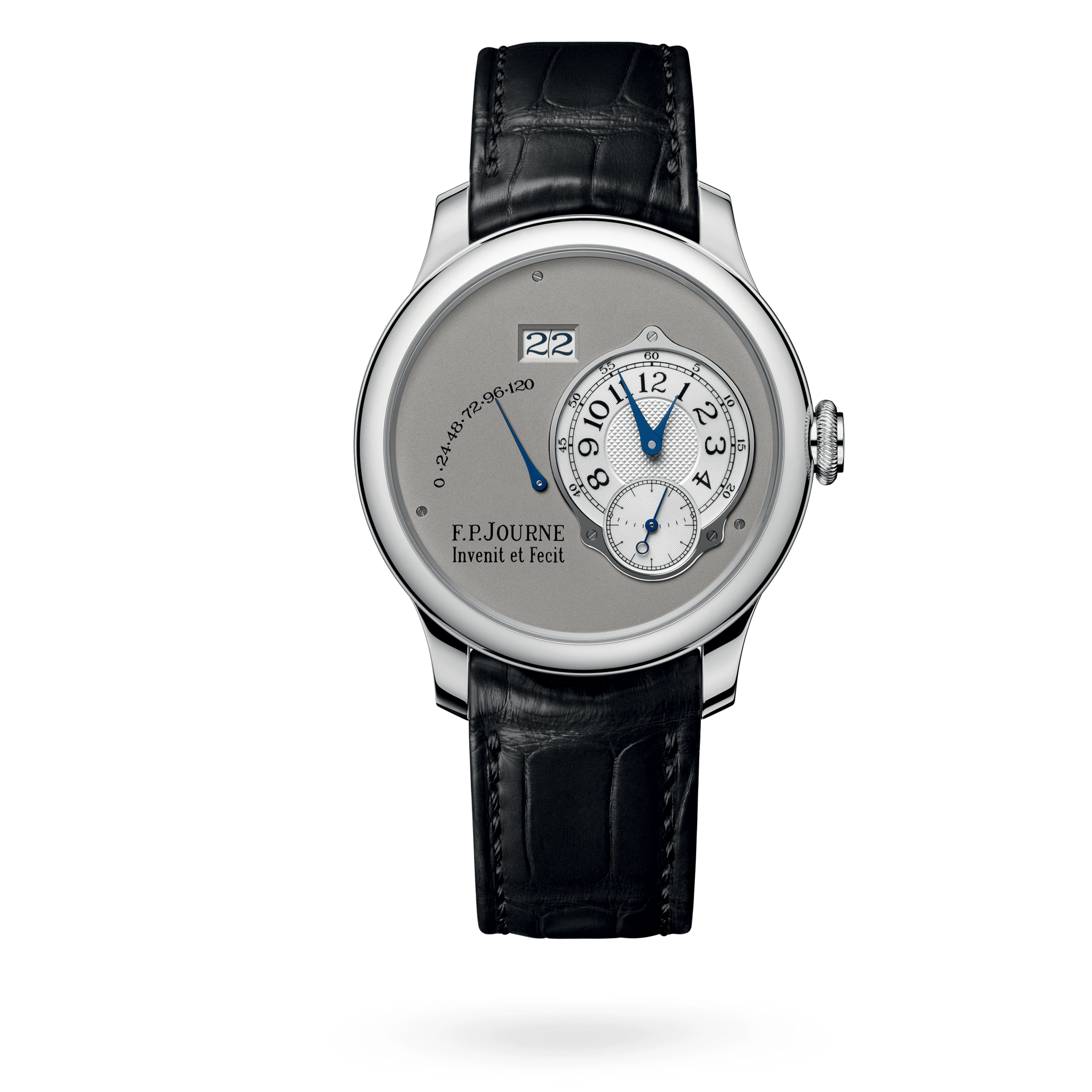
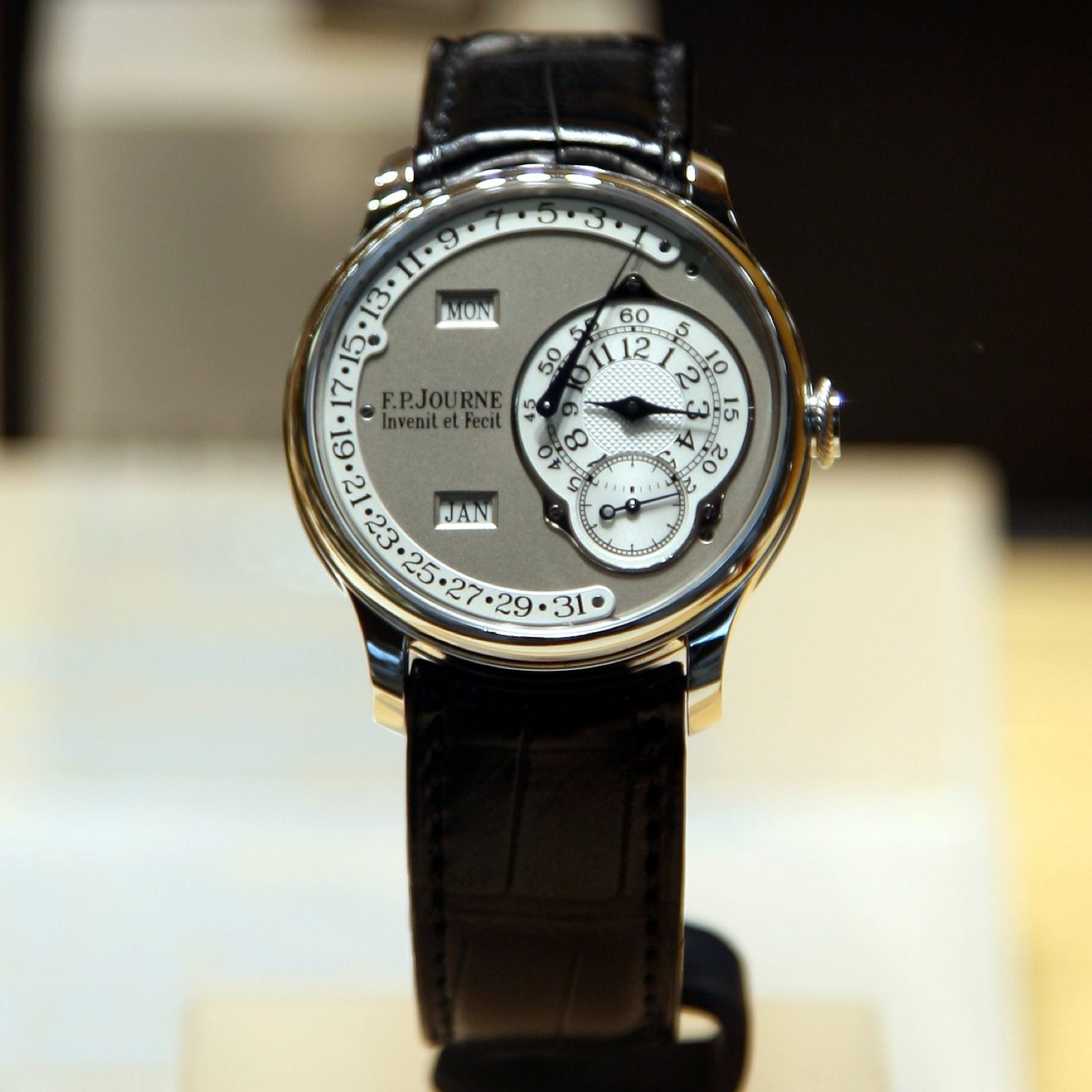
The Octa Reserve de Marche adds a power reserve indicator to Journe's self-winding Octa platform; secondary prices are slightly above the Octa Automatique, reflecting the additional complication and its visual interest.
Editorial estimate, 2026 Q2. Actual prices vary by condition, date, and box/papers status.
In-house manufacture caliber · caliber F.P. Journe Cal. 1300: in-house automatic, 21,600bph, 120h (5-day) PR; remontoire d'egalite constant-force mechanism delivers consistent torque to the escapement; natural escapement without lever · 120h power reserve (5 days)
Medium-large: suits wrists 6.5 in+ (16.5 cm+)
40 mm case. Wears confidently on average to larger wrists. May overhang on slender builds.
Not yet rated
Community + OSINT signals haven’t landed for this reference yet. We don’t publish a rating against zero signal: the number would mean nothing. Editorial body + caliber + market value still surface above; ratings appear once the signal corpus does.
Retrograde date hand sweeping left to right distinguishes the Octa RDM from all other Octa variants
Known issues in the market
Octa platform confusion is frequent; verify it is specifically the RDM (retrograde date mystery) variant
Date hand retrograde function must be observed: hand sweeps 1-31, then snaps back to 1
Annual calendar corrects automatically for 30/31-day months; verify this is functional
Area
What to check
What is correct
Red flag
dial
Retrograde date display
"RDM" designation on dial; date scale running 1-31 across an arc; single sweeping hand (not rotating disc); "Automatique" designation; "F.P.Journe Genève" signing
Missing "RDM"; rotating disc date rather than sweeping hand; standard date window; incorrect signing
movement
Octa calibre 1300 with retrograde mechanism
Peripheral rotor; 120-hour power reserve; retrograde cam and spring-loaded rack visible through display caseback; annual calendar mechanism corrects automatically for 30-day months
Central rotor; different power reserve specification; no retrograde mechanism visible; wrong calibre number
case
Octa case with crown at 12
42mm diameter; crown at 12; tantalum, rose gold, platinum, or yellow gold per documented series
Crown at 3; incorrect case diameter; case material inconsistent with documented RDM production
Common legitimate replacements
Retrograde spring mechanism is a service point; ask for documented service history.
Annual calendar requires no monthly correction but does require one adjustment per year in late February.
Expert resources: FP Journe Genève for serial lookup. Purists.com Octa platform documentation covers all RDM variants with dial comparisons.
Authentication guide
Last reviewed June 2026
The Octa RDM introduced in 2001 was FPJ's first automatic and the first automatic movement to deliver more than 120 hours of reserve. Cal. 1300 gets there with a single metre-long mainspring wound by a 22k gold rotor, which limits amplitude loss to about 25 percent across five days. There is no remontoir in this caliber and no platinum micro-rotor; the rotor is 22k gold.
Known reproduction risks
toggle
HIGH RISK
Non-FPJ movement with standard full rotor in Octa RDM case
Full rotor bridge visible through the caseback instead of the micro-rotor
Movement plates without gold coloring
Power reserve indicator that reads less than 5 days at full wind
HIGH RISK
A watch on a steel bracelet with a rotating bezel, described as an Octa or as an "Octa S"
A steel bracelet or a steel case -- F.P. Journe has not offered an Octa on a steel bracelet, and no Octa reference is cased in steel
A rotating bezel -- the Octa family does not use one, and the RDM bezel is fixed
An "Octa S" or "Octa Sport" designation on the dial, caseback or paperwork -- F.P. Journe has no model by that name
No fan-shaped power reserve arc across the upper dial, which every Octa RDM carries
Journe's sports line is the lineSport, not the Octa. The lineSport Chronographe Monopoussoir Rattrapante (CMS) is titanium and runs Cal. 1518, a different case and movement family from the Octa entirely. Journe case metals are gold, platinum, tantalum and titanium, so steel in the case or bracelet is on its own enough to say the watch is not the reference the description names.
MEDIUM
Genuine FPJ CS/CB movement (Cal. 1304) fitted into Octa RDM case
No micro-rotor visible through caseback -- Cal. 1304 is manual-wind
Power reserve arc graduating to 40 hours rather than 5 days
A Cal. 1304 in an Octa case is detectable by the missing micro-rotor and the 40h vs. 120h reserve discrepancy. Movement swaps within the FPJ family sometimes occur at service.
Dial variants by era
toggle
Era
Description
Identifiers
2001 to 2013 (first generation)
Early Octa RDM with the fan-shaped power reserve arc across the upper dial. Available in silver, champagne, and blue sector dials.
Fan-shaped power reserve arc spanning the upper third of the dial, graduated 0 to 5 days (or 0 to 120H)
Date window at 3 with no cyclops
Small seconds sub-dial at 9
FPJ Arabic numerals in the same typeface as CS/CB
No model name on dial face in early production
2013 to present (second generation)
Revised Octa RDM with updated movement architecture and refined dial proportions.
Same fan-shaped power reserve arc but with slightly larger arc radius than early pieces
"OCTA RESERVE DE MARCHE" text added to dial in current production
Dial sectors in the same material options with refined finishing quality
Service part flags
toggle
Platinum micro-rotor
Original: The Octa RDM was the first watch to use a platinum micro-rotor. It is integrated at movement plate level and visible through the caseback as a small, dense, grey-white semicircle. Its platinum composition gives it a specific grey-white color distinct from steel or gold rotors.
Replacement tells
Full-bridge rotor visible through caseback -- genuine RDM has only the small micro-rotor, not a full rotor bridge
Micro-rotor in gold or steel color rather than the grey-white of platinum
No rotor visible at all -- the RDM is automatic and the micro-rotor should always be present
Power reserve arc
Original: The 5-day arc indicator is displayed via a sector aperture. The indicator hand should advance steadily over the 120-hour rated reserve.
Replacement tells
Power reserve arc graduated to 40 or 42 hours -- this indicates a CS or CB movement fitted in an Octa case
Indicator hand that jumps rather than advancing continuously
Arc scale with different markings than the 0-5 day (or 0-120h) sectors
Movement (Cal. 1300)
Original: 18k rose gold plates and bridges, same as all post-2003 FPJ calibers. Cal. 1300 is distinguishable from Cal. 1304 (CS/CB) by being automatic, by its 22k gold rotor, and by the 120-hour reserve from a single long mainspring rather than 56 hours from twin barrels.
Replacement tells
Silver or grey movement plates -- same disqualifier as all FPJ references
Any periodic stepping cadence on the seconds display -- neither Cal. 1300 nor Cal. 1304 has a remontoir
Case thickness measurably beyond 10.8mm
Case back markings
toggle
2001 to present
"RDM" reference designation on caseback
"CAL. 1300" movement designation
"F.P. JOURNE" and "GENEVE"
Serial number and case material designation
30M water resistance
Movement tells
toggle
Power reserve is 120 hours (5 days). With a fresh mainspring the arc indicator should advance uniformly across 5 days. Dropping to reserve before 100 hours indicates mainspring service is needed.
Balance is free-sprung, 10.1mm across, adjusted by five turning weights at 21,600 vph. F.P. Journe cites the metre-long mainspring as holding amplitude loss to about 25 percent over the five days, so a movement that falls off sharply in the last day wants attention.
Wearing the RDM through a normal day should advance the power reserve indicator noticeably. If the reserve does not advance with typical wrist motion, the winding mechanism needs attention.