Originality matters on this reference. An original dial and hands command a significant premium. Service replacements typically trade at a 20-40% discount to original examples.
Live pricing is coming soon. Get notified when it is available for this reference.
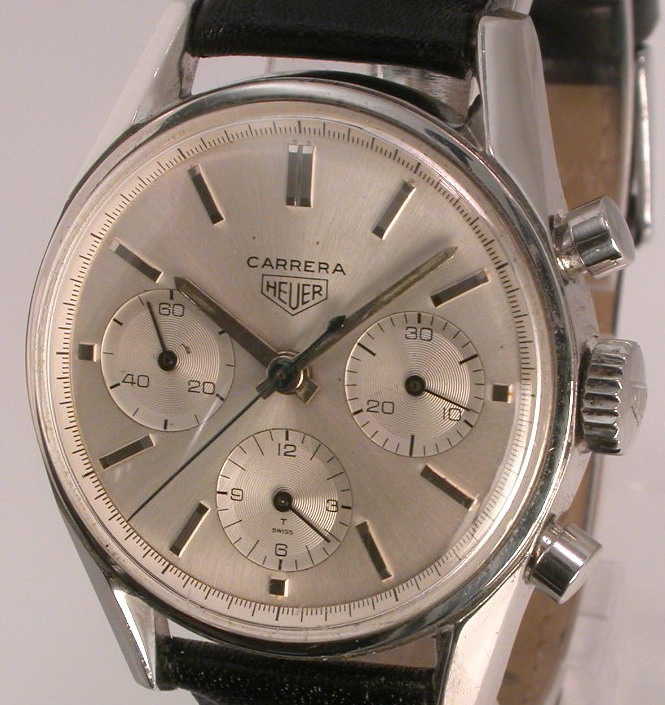
The 2447 is the first-generation Heuer Carrera, designed in 1963 by Jack Heuer as a 'clean, legible, racing chronograph,' 36mm steel case, Valjoux 72 caliber, no rotating bezel and no extraneous text on the dial. The reference defined the look that every modern Carrera traces back to.
Heuer launched the Carrera in 1963; the 2447 designation covers the first-generation 36mm cases produced 1963 through ~1969. Multiple dial variants exist, 2447N (black), 2447S (silver), 2447NT (black/tropical-aged), 2447SN (panda silver dial with black sub-registers), and the racing-themed 'Carrera 12' / 'Carrera 45' which mark the chronograph register count. The Valjoux 72 caliber is the same column-wheel chronograph movement used by the early Daytona, by the vintage Universal Genève Compax, and by countless mid-century chronographs of note.
Common things to check: dial originality (refinished dials are extremely common on vintage Carreras and visible under loupe, soft printing edges, sub-register printing depth); hands (luminous-tipped hands often replaced with non-lumed reproductions); bezel (the polished steel bezel rolls down to the case; over-polishing rounds the transition); case (36mm wears as 38-39mm by modern proportions but is firmly vintage-thin at ~13mm); the original Heuer signed crown should be present and unworn; bracelet originality is largely a non-issue, most 2447s came on leather and stay on leather.
The 2447 has firmed steadily over the last decade as vintage chronograph collecting matured. 2447NT (tropical) and 2447SN (panda) variants carry premiums; the panda is the most-replicated, so provenance research matters. Full-set examples with paperwork are still findable but increasingly rare.
Valjoux 72 service is performed by Heuer-experienced independent watchmakers; the brand's modern TAG Heuer service center handles them but is sometimes more conservative than the vintage market wants. Service intervals of 5-7 years are typical. The column-wheel chronograph mechanism is the failure point, a chronograph that resets crisply on all three subdials is healthy; sticky or misaligned reset is a service flag.
Community + OSINT signals haven’t landed for this reference yet. We don’t publish a rating against zero signal — the number would mean nothing. Editorial body + caliber + market value still surface above; ratings appear once the signal corpus does.
The first Carrera dial typeface and register arrangement is the primary authentication marker; examine all text under magnification before any purchase.
| Area | What to check | What is correct | Red flag |
|---|---|---|---|
| dial | Dial typeface and register arrangement | Original Carrera typeface and register arrangement consistent across 1963-1969 production; clean printing under magnification | Typeface inconsistency or register arrangement deviation; re-dial or non-genuine dial |
| crown | Signed Heuer crown | Crown signed "Heuer"; correct for 2447 | Unsigned or non-Heuer crown; replacement crown |
| movement | Valjoux Cal. 72 architecture | Valjoux 72 manual-wind column-wheel chronograph; consistent with 1963-1969 production | Non-Valjoux-72 movement; movement swap or non-genuine watch |
The Carrera ref. 2447 is a 1960s-70s manual-wind chronograph using the Valjoux 72 or 92. Authentication requires consistent patina across dial, hands, and case; any single element that does not age consistently with the others is a red flag.
| Era |
|---|
| Description |
|---|
| Identifiers |
|---|
| 1963 to 1968 (early production) | White, black, or silver dial with two or three contrasting registers. "HEUER" in block letters at 12. "CARRERA" below. No lume on most early references; printed indices only. Small seconds at 9, 30-minute counter at 3. |
|
| 1968 to 1975 (later production) | Same basic layout with some dial variations including coloured registers and different typeface generations. |
|