GrailAtlasAn independent mechanical watch reference
العربية

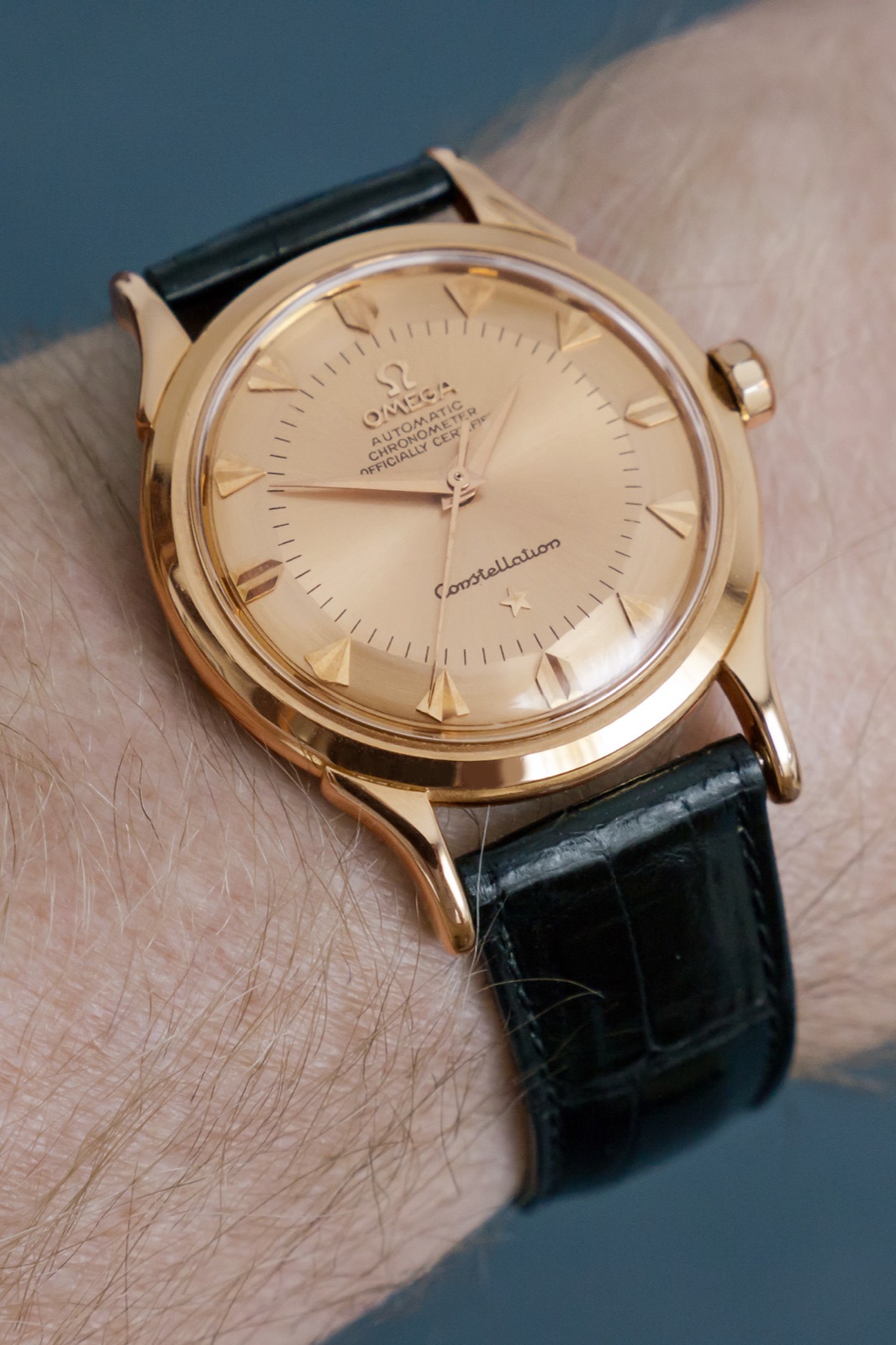
The original pie-pan dial Constellation of the 1950s-1960s established the Observatory prize association that defined the entire Constellation identity.

Rarelandmark#1 in familyOfficial press photos

Originality

Originality matters on this reference. An original dial and hands command a significant premium. Service replacements typically trade at a 20-40% discount to original examples.

Live pricing is coming soon. Get notified when it is available for this reference.

In-house manufacture caliber · caliber Omega Cal. 561: automatic, 19,800bph, 44h PR, 24j; full-rotor predecessor to 562; used in pie-pan Constellation from late 1950s · 44h power reserve
Small case: suits slender wrists (under 6.5 in / 16.5 cm)
34 mm case. A compact, elegant wear. Particularly at home on narrower wrists where larger cases can overhang.

Not yet rated

Community + OSINT signals haven’t landed for this reference yet. We don’t publish a rating against zero signal: the number would mean nothing. Editorial body + caliber + market value still surface above; ratings appear once the signal corpus does.

Search pre-owned listings

Chrono24
eBay (sold listings)
WatchBox

Authentication

Stepped "pie pan" dial with raised outer chapter ring must be original and un-restored; a refinished pie pan dial is worth a fraction of an original

Known issues in the market
  • Dial refinishing destroys the stepped profile and the delicate lacquer finish; any flat or repainted dial is a significant problem
  • Observatory caseback with the star design must be present; smooth solid caseback indicates a non-Constellation
  • Cal. 564 or 561 are correct for this era; verify calibre via caseback opening
  • Pie pan dial restoration is common and difficult to detect without experience; patina and edge definition are the tells
AreaWhat to checkWhat is correctRed flag
dialStepped pie pan profile and original finishRaised outer chapter ring creates a stepped "pie pan" profile; original silver or champagne lacquer with patina consistent with age; applied baton indices; "Omega" at 12 and "Constellation" below; no date window on base variantsFlat dial without stepped profile (refinished); uniform, too-bright finish without age patina; indices with adhesive visible at base; date window on no-date variant
casebackObservatory and star caseback design"Constellation" text around the edge; observatory building engraving; 5-pointed star medallion; "Chronometer officially certified" text; serial and calibre on caseback or movementSmooth or plain caseback (non-Constellation movement donor); observatory engraving absent; caseback from a different Omega model
movementCal. 564 or 561 chronometerCal. 564 (or 561/562) with COSC or observatory chronometer certification; automatic rotor; movement decoration consistent with Omega standard; "Omega" on movement plateIncorrect calibre; non-chronometer movement (Constellation designation requires certification); quartz movement in a claimed vintage mechanical
Common legitimate replacements
  • Leather strap is standard; original Omega pigskin or integrated bracelet variants have different value profiles.
  • Acrylic crystal is period-correct; sapphire replacement is common but reduces collectible status.
Expert resources: Omega Museum in Biel and Omega service for serial authentication. OmegaForums.net and Watchuseek Omega board have extensive pie pan dial documentation including refinish detection guides.

Authentication guide

Last reviewed June 2026

The Pie Pan is named for its stepped dial architecture -- a raised surround with a concave center visible from the side. Dial refinishing is the primary authenticity concern. Original dials have hand-applied text with legible irregularities; refinished dials look too clean.
Known reproduction risks

toggle
MEDIUM

Movement swap -- cheaper caliber in a genuine Constellation case

  • Caseback or movement bridges show a non-Constellation caliber number
  • Movement architecture visible through display caseback does not match 500-series or 550-series bridge design
  • Watch wound and set behaves differently from the stated caliber's winding specification

Outright fakes of the Pie Pan are rare. Movement swaps into attractive cases are the documented concern -- particularly replacing an original chronometer-grade caliber with a lower-grade movement.

MEDIUM

Dial refinishing

  • Printing looks perfectly uniform under 10x -- no natural hand-application irregularities
  • Typeface weight differs from period-correct Omega typography
  • Surface texture of the dial field has been altered -- original matte texture is distinctive

Refinished dials are the highest-frequency issue on vintage Constellations. A refinished dial on an otherwise genuine watch is a significant value reduction and should be reflected in the price.

LOW

Incorrect caseback star count

  • Fewer than eight stars around the observatory engraving
  • Observatory engraving depth shallower than correct examples -- surface stamp rather than deep cut

Dial variants by era

toggle
EraDescriptionIdentifiers
1952 to 1969Classic "C"-case variant with curved lugs and the signature stepped "pie pan" dial. The dial has a raised outer ring and a slightly recessed center field, creating the concave appearance from above. Silvered matte and champagne are the two main colorways. Applied faceted baton indices at each hour, with a small seconds subdial at 6 o'clock on manual examples.
  • Stepped dial surround visible from any angle -- the "pie pan" step is the defining feature
  • Applied faceted baton indices, not painted or printed
  • Period Omega typography for "Constellation" text, slightly hand-placed under magnification
  • Small seconds subdial at 6 o'clock on manual calibers (500, 501, 504, 505)
  • "Chronometer" text present only on COSC-certified examples -- uncertified dials omit it
1960 to 1969Later "TV screen" case Constellations exist but are a distinct model with a different case shape. Avoid conflating the two -- the Pie Pan name applies specifically to the round-case stepped-dial format.
  • Round case with curved lugs -- "TV screen" is rectangular, a separate reference
  • Same stepped dial construction but later calibers (551, 561, 562 automatic) in this era
  • Automatic examples have no small seconds subdial

Service part flags

toggle
Dial

Original: Hand-applied text with period Omega typeface. Under 10x magnification, original dials show slight irregularities in letter placement and ink weight -- these are natural artifacts of hand-application, not defects. The stepped surround has clean edges with no refinishing overspray.

Replacement tells
  • Perfectly uniform printing under magnification -- original dials are not offset-printed
  • Incorrect typeface weight or letter spacing on "Constellation" or "Chronometer" text
  • Refinishing overspray visible at the edge of the stepped ring
  • Loss of the original matte texture -- refinished dials often appear flatter or slightly shinier
Crown

Original: Push-pull crown with no screw-down mechanism. Knurling matches period Omega specifications. The crown is easily replaced and non-original crowns are common on serviced examples.

Replacement tells
  • Screw-down crown on a Pie Pan -- this caliber family has no screw-down
  • Crown knurling too deep or too fine relative to period Omega standard
  • No Omega logo stamp on the crown face, or logo poorly pressed
Movement caliber

Original: Manual examples use caliber 500, 501, 504, or 505. Automatic examples use 551, 561, or 562. The caliber should match the era and the stated specification. Verify via a display caseback or from a watchmaker's report.

Replacement tells
  • Caliber number on caseback or movement does not match the dial markings or seller description
  • Movement shows an automatic rotor on a watch sold as a manual-wind example
  • Non-Omega caliber visible -- cheaper movements have been swapped into attractive Constellation cases

Case back markings

toggle
1952 to 1969
  • Constellation observatory motif -- a domed building with a pointed roof flanked by stars
  • Eight stars around the observatory in correct count -- service-replaced casebacks sometimes have six or ten
  • Deep engraving on the observatory motif, not a surface-level stamp
  • Case reference number and serial number engraved
  • "SWISS MADE" and "STAINLESS STEEL" or metal designation

Movement tells

toggle
  • Caliber 500-series manual movements wind with a progressive resistance that builds across the full crown stroke. A movement that winds loosely all the way or clicks out early has a mainspring or ratchet issue.
  • The 551 and 561 automatic calibers use a bidirectional winding rotor. Worn rotor bearings produce an audible rattle when the watch is moved -- a silent rotor is correct; any rattle warrants inspection.
  • All Pie Pan calibers in this era are COSC-certified only if the dial says "Chronometer." A watch without that text is not a chronometer regardless of what a seller claims. Period COSC certification is dial-stated, period.
  • Service history should include documentation of caliber identity. An authorized Omega service will note the caliber. Non-authorized service with no records is a flag to verify movement identity independently.
Sources: Omega official heritage; WatchUSeek Omega forum.

You might also like

Omega Constellation Globemaster (Master Chronometer) Ref. 130.30.39.21.02.001, blue dial, steel case
Omega
Constellation
Ref. 130.30.39.21.02.001
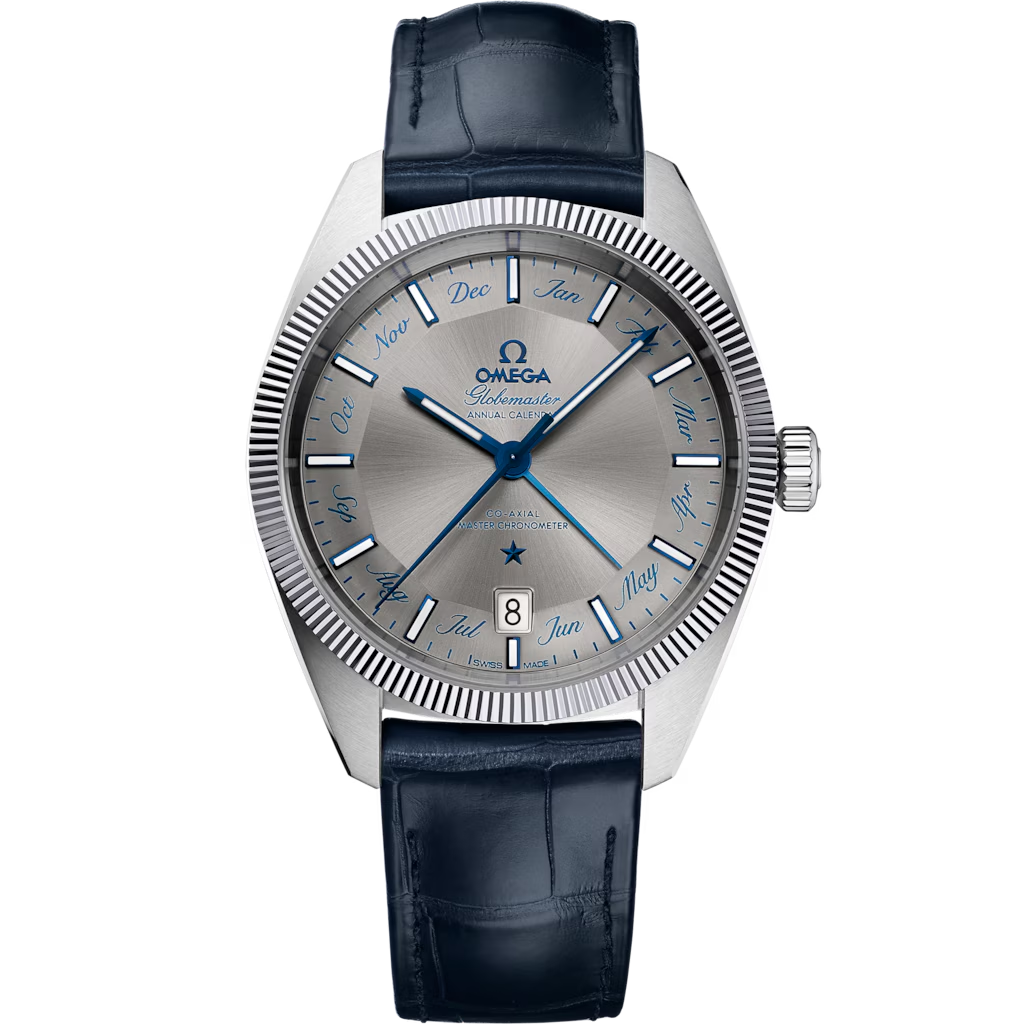
Omega Constellation Globemaster Annual Calendar Ref. 130.33.41.22.06.001, silver dial, steel case
Omega
Constellation
Ref. 130.33.41.22.06.001
Omega Constellation, Modern 41mm Ref. 131.20.41.41.06.001, black dial, steel case
Omega
Constellation
Ref. 131.20.41.41.06.001
Omega
Constellation
Ref. 123.10.39.21.02.001
Rolex Datejust Ref. 16234, black dial, steel case
Rolex
Datejust
Ref. 16234
Rolex Day-Date 36 (Vintage White Gold) Ref. 1803, champagne dial, gold-white case
Rolex
Day-Date
Ref. 1803

Buying guidance

← Back to Grail Atlas