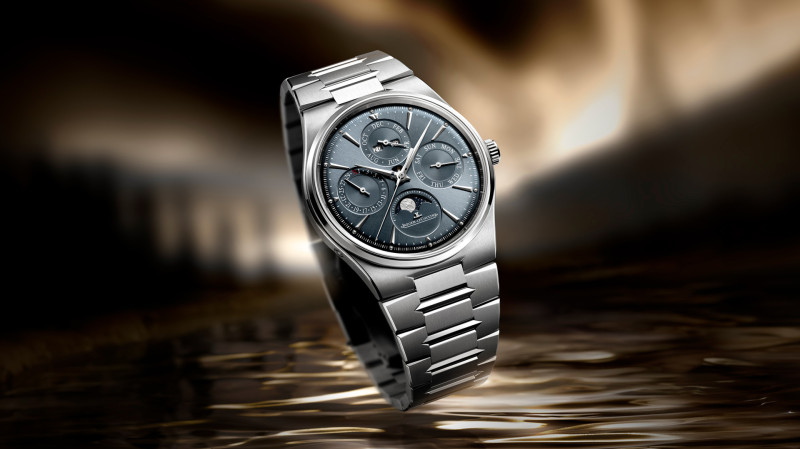
The Master Perpetual Calendar in steel is one of the better values in the perpetual calendar category; secondary prices are stable because the in-house caliber is reliable and the steel case is relatively uncommon for a watch at this complication level.
Editorial estimate, 2026 Q2. Actual prices vary by condition, date, and box/papers status.
Movement tier: unclassified · caliber JLC Cal. 868/1: automatic perpetual calendar, 28,800bph, 43h PR, 40j; perpetual day/date/month/year display with moon phase; no manual correction needed until 2100 · 43h power reserve
Medium-large: suits wrists 6.5 in+ (16.5 cm+)
40 mm case. Wears confidently on average to larger wrists. May overhang on slender builds.
Not yet rated
Community + OSINT signals haven’t landed for this reference yet. We don’t publish a rating against zero signal: the number would mean nothing. Editorial body + caliber + market value still surface above; ratings appear once the signal corpus does.
Any caliber other than 868/1; missing bridge components in the perpetual calendar module
crown
Calendar advance function safety
Calendar correctors operate smoothly with no binding; no evidence of calendar advance during forbidden hours
Any resistance in calendar corrector operation; service history showing incorrect advancement protocol
Common legitimate replacements
The perpetual calendar module is a high-value JLC component; verify service was performed by JLC or an authorized service center with perpetual calendar experience.
The Master Perpetual Calendar is JLC's full-complication perpetual calendar: day, date, month, leap year, and moonphase all displayed simultaneously. Verifying that all indications advance correctly through at least one calendar cycle and that none require manual correction except for the defined manual operations is the functional authentication standard.
Known reproduction risks
toggle
HIGH RISK
Annual calendar mechanism misrepresented as perpetual
Calendar requiring correction at the end of 30-day months -- annual calendar only handles those months automatically; it does not handle leap year
Missing leap year indicator on the dial
MEDIUM
Incorrect caliber in caseback
Movement without Cal. 866 designation
Calendar module visible through caseback that does not match the known perpetual calendar architecture
Dial variants by era
toggle
Era
Description
Identifiers
2020 to present (current Q5013480)
Blue or silver dial with the full perpetual calendar layout. Five calendar indications plus moonphase arranged around the dial field.
Day aperture, month aperture, date pointer or sector, leap year indicator, moonphase at 6 -- all five indications present on the dial
"PERPETUAL CALENDAR" text on dial
Applied polished indices; no Arabic numerals on most variants
"JAEGER-LECOULTRE" and "MASTER" text
Steel case with exhibition caseback
Service part flags
toggle
Perpetual calendar mechanism
Original: Cal. 866 perpetual calendar. The mechanism advances through all months automatically, including February in both standard and leap years. No manual correction should be required at any month end.
Replacement tells
Calendar requiring correction at end of any month -- a genuine perpetual calendar needs no manual intervention except for setting after service (or after battery change, which is not applicable here)
Leap year indicator that does not advance at the correct four-year cycle
Any calendar indication that advances sluggishly or in multiple steps at midnight
Moonphase display
Original: Blue enamel sky with standard JLC moonphase disc quality.
Replacement tells
Moonphase not aligned with the actual current lunar phase
Flat or printed sky background
Case back markings
toggle
All Q5013480 production
Exhibition caseback with Cal. 866 engraved
"JAEGER-LECOULTRE" and serial number
Reference Q5013480 on caseback or between lugs
"PERPETUAL CALENDAR" text on caseback in some production runs
Movement tells
toggle
Perpetual calendar post-service requires complete calendar setting across all five indications -- ask for the date the calendar was last verified against actual calendar date
The leap year mechanism should be tested on the bench: advance the calendar through a simulated February 28 in a non-leap year and confirm the calendar advances to March 1, not February 29