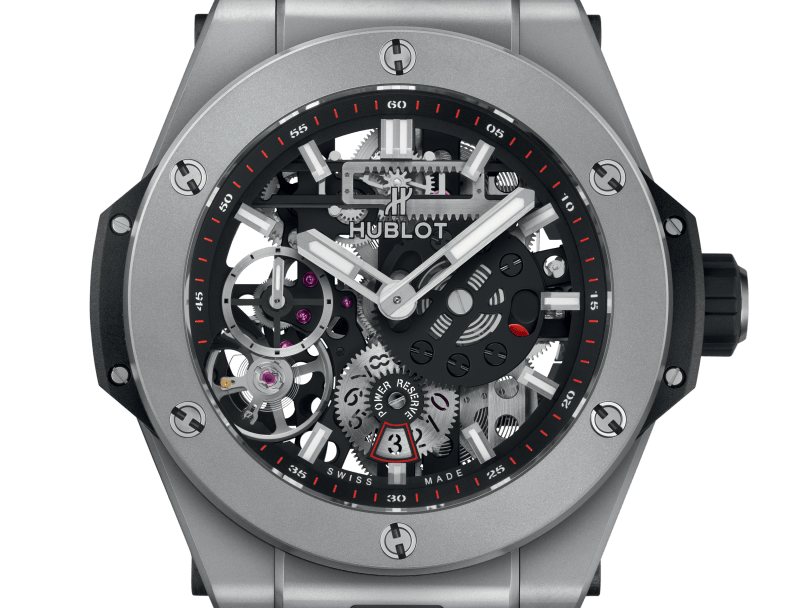
The Big Bang Integral solves the problem the original Big Bang always had: the afterthought bracelet. Hublot designed the case and bracelet as a single object from the start, and the 40mm version brings that integrated format to a wearable size without shrinking the design into something timid.
What it is
The Big Bang arrived in 2005 as Hublot's relaunch vehicle under Jean-Claude Biver, fusing a rubber strap with a bold case architecture that mixed materials in a way the industry had not seen at that price point. The Integral variant came in 2019, addressing the one persistent criticism of the line: that the bracelet never felt native to the case. Hublot built the Integral bracelet with the same H-shaped links that echo the lug geometry, and the 40mm sizing came alongside the 42mm at launch, targeting buyers who found the standard Big Bang too large for daily wear.
The HUB1213 automatic was developed in-house and gave the Integral genuine manufacture credibility rather than relying on a supplied base. The titanium execution keeps the watch lighter than its visual weight suggests, which is the practical argument for the Integral over ceramic or King Gold variants.
Buying notes
The bracelet integration that defines this watch is also its most demanding maintenance point: the link construction traps debris at the case junction and requires more frequent cleaning than a conventional bracelet to avoid accelerating surface wear. Titanium scratches easily and the brushed surfaces on the case flanks show contact marks quickly; a polished-finish variant would hide wear better but Hublot does not offer one in this reference. The 451.EX.1120.EX uses an "Extra" titanium designation that is functionally standard Grade 5 titanium, so do not pay a premium for the material designation on the secondary market.
Lug tube wear is a known issue on pre-owned Big Bang Integrals from the first production years (2019-2020); ask for a service history or inspect the strap attachment points before buying used. The 100m water resistance rating is adequate but the crown and pushers on this reference are not screw-down, so observe the rating conservatively.
Market read
New retail on the 451.EX.1120.EX sits around $17,000-19,000 depending on region and authorized dealer relationship. The secondary market trades at a modest discount to retail, typically 10-15%, which reflects Hublot's position as a brand with strong boutique presence but less scarcity than its pricing implies. Demand is steady rather than speculative, and values have not moved significantly since the Integral's launch year, making this a stable buy rather than a collector play.
Service expectations
The HUB1213 is a manufacture automatic with an approximately 50-hour power reserve; Hublot recommends service intervals of five to seven years. Independent watchmakers with Hublot training can service it, but the integrated bracelet requires disassembly for full movement access, adding time and cost relative to a standard bracelet configuration. Budget $800-1,400 for a full service at an independent, or expect higher at a Hublot service center.
Editorial copy is AI-drafted from primary sources and reviewed by Grail Atlas before publication. Where the text is uncertain about a fact, it says so. Email
corrections@grailatlas.com if something reads wrong. Signals on this page (community, OSINT) are clearly separated from the editorial sections.