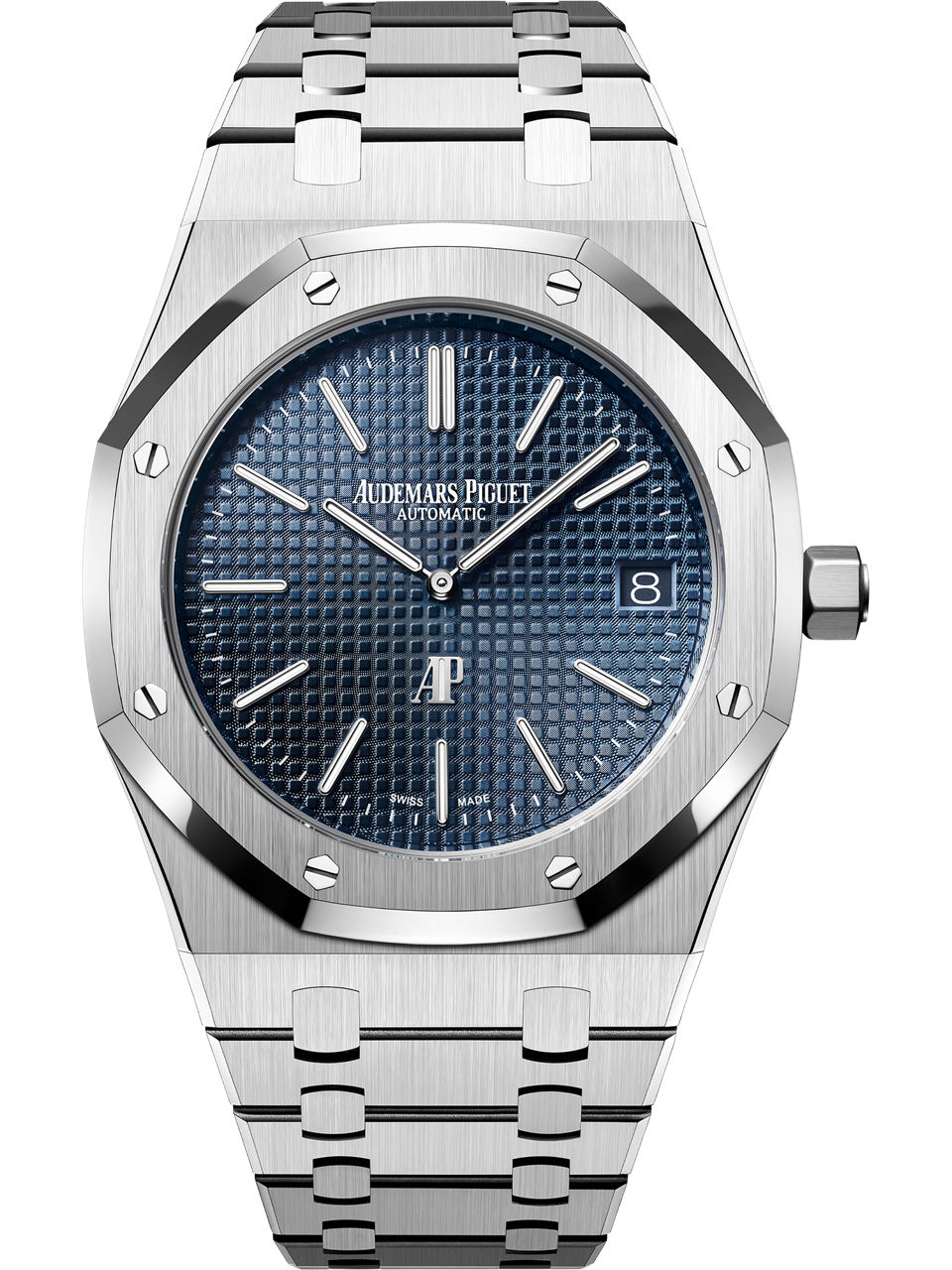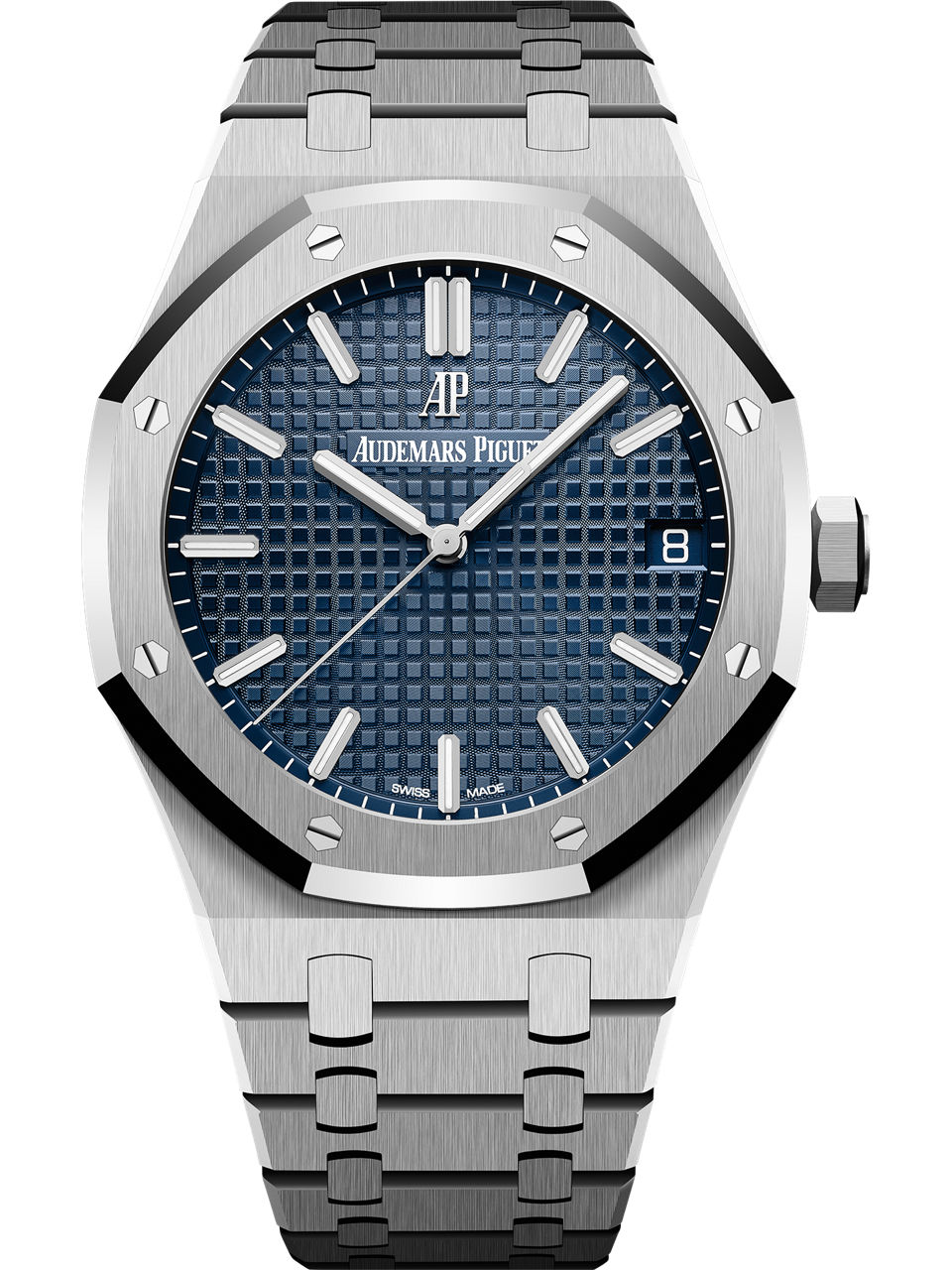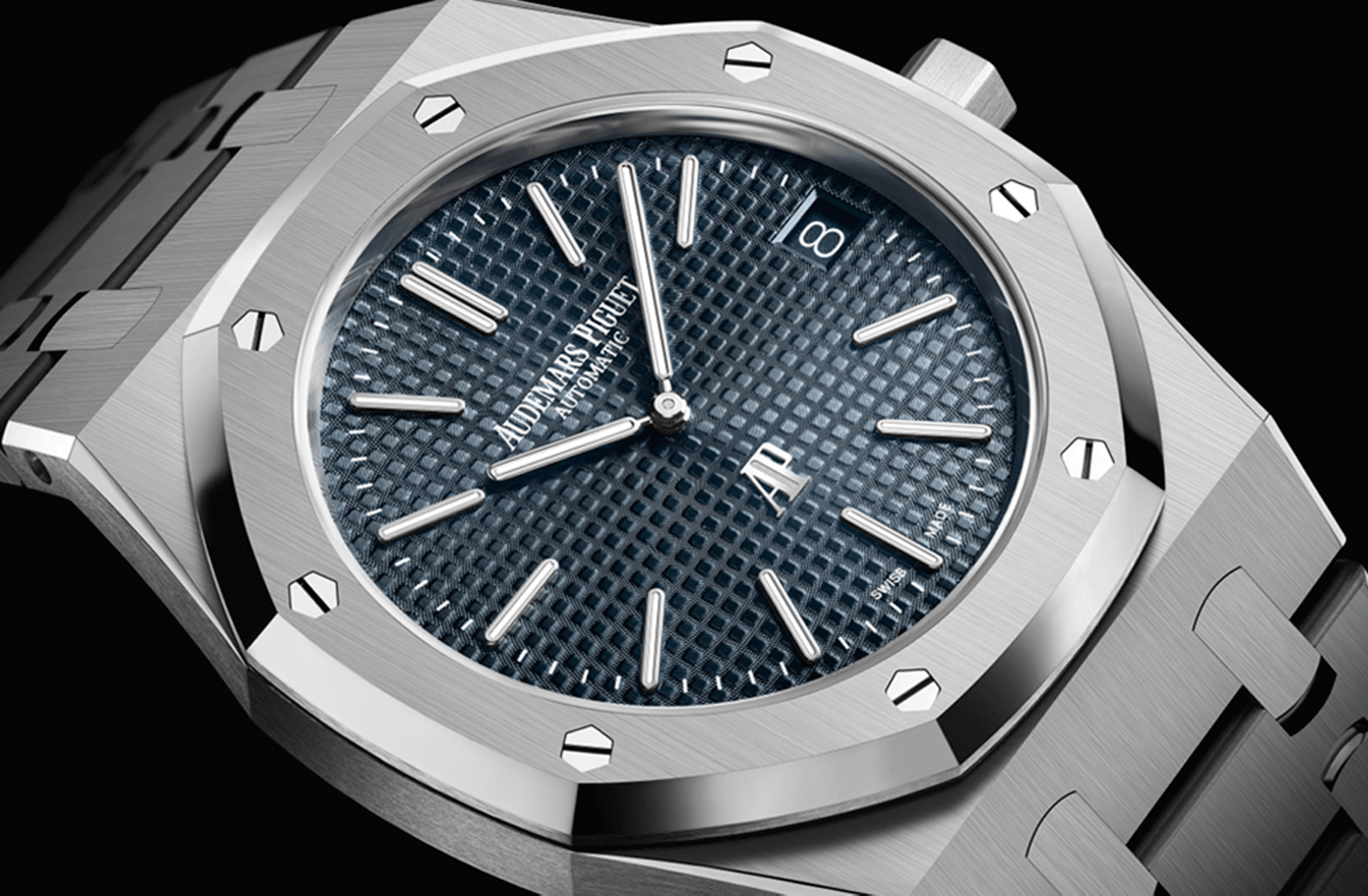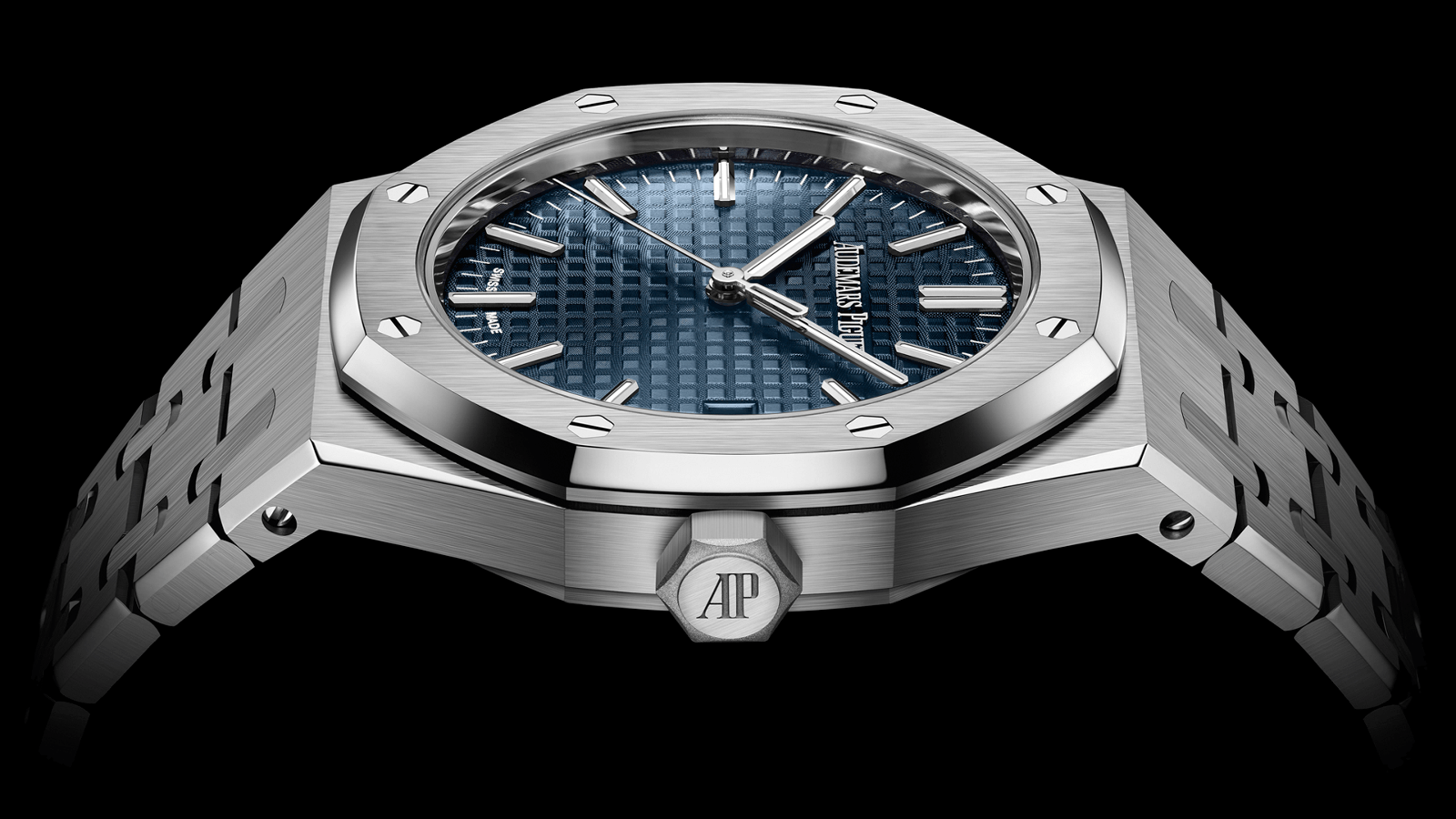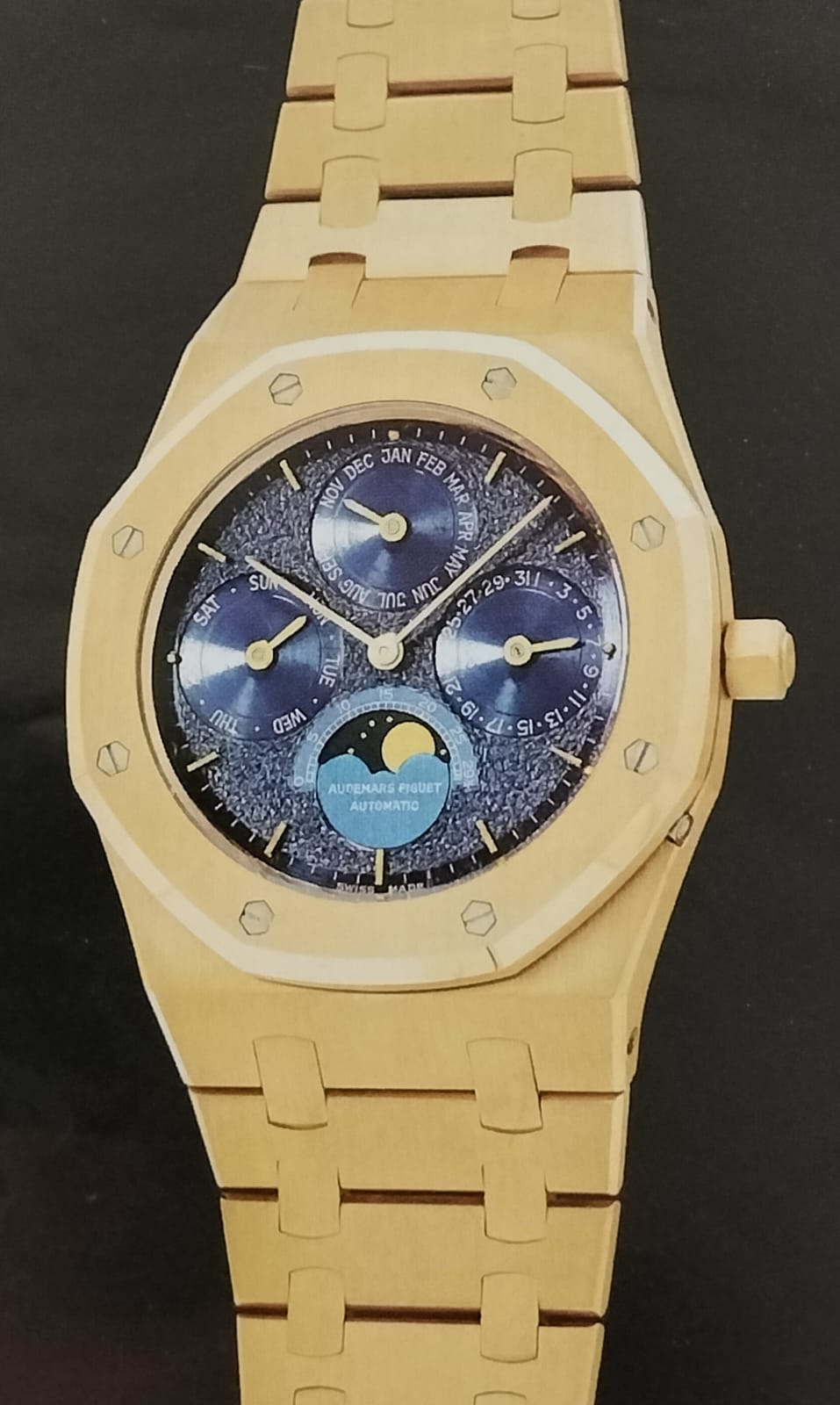
The Royal Oak Perpetual Calendar in steel is among the most sought complications in the AP catalog; secondary prices corrected from the 2021-2022 peak but remain well above retail for clean, complete examples.
The Royal Oak Perpetual Calendar 41mm packs one of the most mechanically demanding complications into a steel sports watch that most brands reserve for precious metal. It runs the 2120/2800, a perpetual calendar module stacked atop the ultra-thin 2120 automatic, and delivers moonphase, day, date, and month on a dial that keeps the tapisserie grid intact. For a steel Royal Oak with a genuine grand complication, this is the reference.
The 26574ST launched around 2016 as a successor to earlier Royal Oak perpetual calendar references in the larger 41mm case format that AP standardized in the 2010s. The movement is the calibre 2120/2800, a periphery-rotor automatic that achieves a 2.75mm movement height before the calendar module -- a genuine engineering constraint given how thin the finished watch sits on the wrist. AP has offered the perpetual calendar in Royal Oak in yellow gold, rose gold, and white gold throughout its history, making a steel reference relatively uncommon and consistently the most sought-after configuration.
The 26574 generation introduced a cleaner layout of the calendar subdials and updated the bracelet finishing to the mix of brushed and polished that defines current production. Production continues today, though AP allocates steel perpetual calendars conservatively relative to total Royal Oak output.
The perpetual calendar module is sensitive to incorrect setting; confirm with any seller that the calendar has not been forced backwards through incorrect crown manipulation, which can damage the mechanism. Ask for service history and confirm the watch has had the movement serviced at an AP-authorized center rather than an independent -- the 2120/2800 requires hands qualified on AP perpetual calendar modules. Inspect the moonphase disc for damage or misalignment, which can occur from magnetism or improper service.
Dial condition matters enormously on tapisserie dials: look for any lifting, cracking at the chapter ring, or refinishing, as AP does not supply replacement tapisserie dials through retail channels. The bracelet on 41mm Royal Oaks of this era develops stretch; check for excessive play between links, especially mid-links, and verify the clasp engages firmly at all positions.
Steel Royal Oak perpetual calendars trade above retail and hold that premium firmly. Current grey market pricing runs roughly $60,000-$80,000 USD depending on condition and papers, against a retail price that AP has historically set in the low-to-mid $40,000s. White and rose gold references sell for more but attract less speculative demand than steel.
Unworn examples with full set -- box, papers, hangtag -- carry a meaningful premium over lightly worn pieces, and that gap is wider here than on simpler Royal Oak references because buyers at this price point are more condition-sensitive. The steel perpetual calendar is one of the few Royal Oak configurations where documented AP service history at an authorized center actively supports price.
Community + OSINT signals haven’t landed for this reference yet. We don’t publish a rating against zero signal — the number would mean nothing. Editorial body + caliber + market value still surface above; ratings appear once the signal corpus does.
Never advance a perpetual calendar between 9pm and midnight; service history confirming correct setting protocol is essential.
| Area | What to check | What is correct | Red flag |
|---|---|---|---|
| dial | Perpetual calendar display completeness | Date, day, month, and leap year indicator all functional and correctly set; leap year must be verified against actual calendar year | Any non-advancing display; leap year indicator inconsistent with current year; any display stuck or jumping erratically |
| caseback | Cal. 2120 ultra-thin automatic | Ultra-thin movement architecture visible; AP finishing; peripheral rotor or micro-rotor consistent with Cal. 2120 specification | Non-AP movement; thicker movement architecture than Cal. 2120 profile; non-matching caliber engraving |
| case | 9.5mm case height | Extremely thin profile consistent with ultra-thin perpetual calendar specification; no case distortion or bowing |
Editorial estimate. Actual prices vary by condition, date, and box/papers status. Live pricing data is in development.
The calibre 2120/2800 should be serviced every 5-7 years at an AP-authorized service center. Expect service costs in the $3,000-$5,000 range for a full perpetual calendar service, which includes disassembly of both the base movement and the calendar module, cleaning, and reagulation. Factor this into your ownership budget, particularly on any pre-owned example that cannot document a recent service.
| Case height inconsistent with 9.5mm specification; any bowing of the caseback indicating movement pressure issues |