GrailAtlasAn independent mechanical watch reference
Français

Last GMT-Master II with an independently adjustable 24-hour hand before the current 126710; the "LNIB" market for this reference is strong.

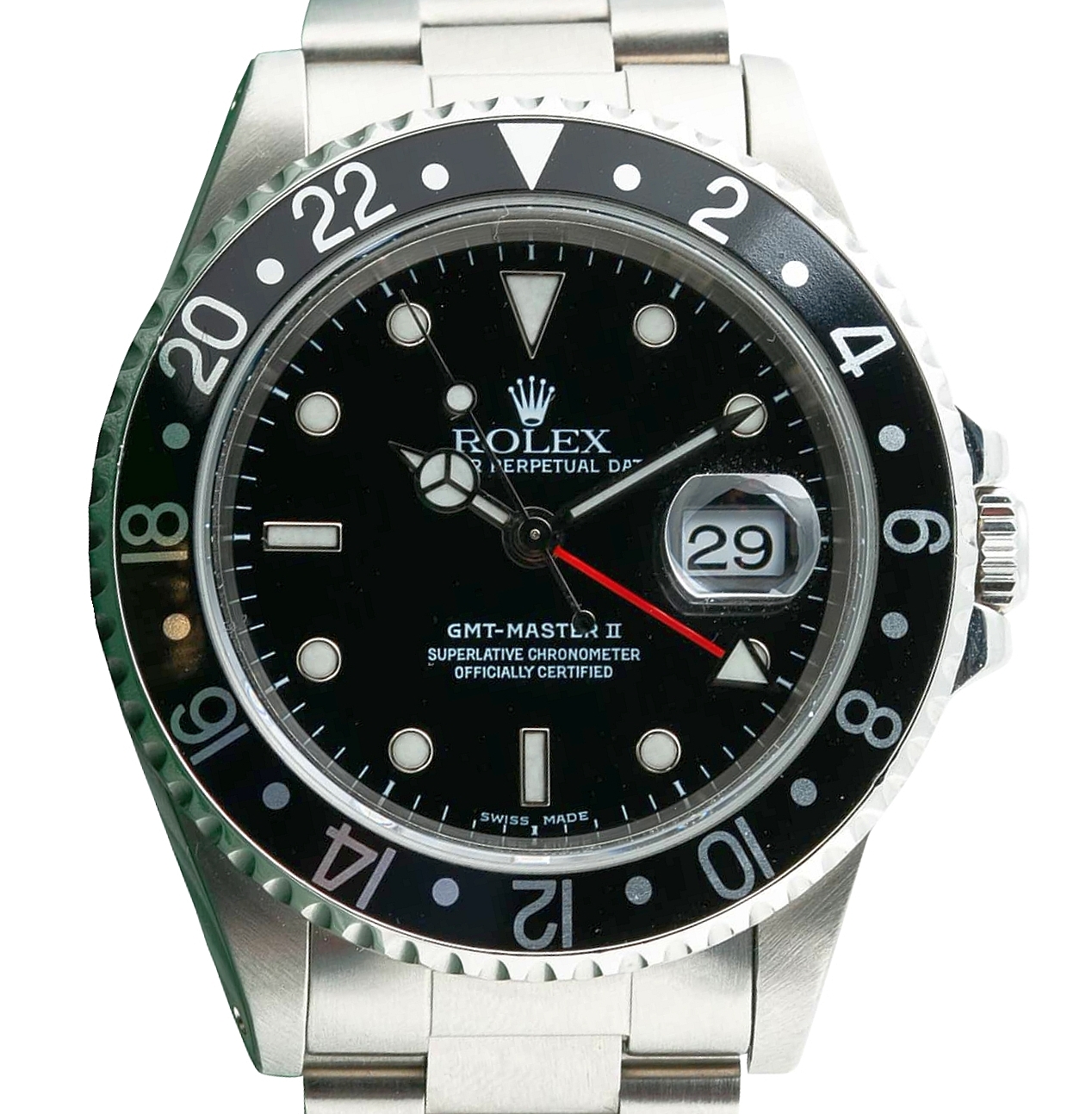
Uncommonmost sought#2 in familyOfficial press photos

Originality

Originality matters on this reference. An original dial and hands command a significant premium. Service replacements typically trade at a 20-40% discount to original examples.

Dial variants

Pepsi bezel (red/blue) with matte dial1988 to 1999UncommonSought
  • Red/blue anodized aluminum bezel insert
  • Flat matte black dial with thin tritium plots
  • SWISS T<25 or Swiss Made underprint
  • Fat font vs later thin-font dials

Early 16710 Pepsi examples with matte dials are harder to find in honest condition than the later glossy versions. Collectors prize the matte surface for its tie to the vintage 1675.

Coke bezel (black/red) with glossy dial1999 to 2007CommonStandard
  • Black/red anodized aluminum bezel insert
  • Glossy lacquered black dial
  • Superluminova plots replacing tritium
  • Thin-font dial printing

The late-production 16710 with Coke bezel and glossy dial is the most common configuration. It is a straightforward buy with no dial-specific premiums or pitfalls beyond the usual bezel fade concerns.

Live pricing is coming soon. Get notified when it is available for this reference.

In-house manufacture caliber · caliber Rolex Cal. 3185: in-house automatic GMT, 28,800bph, 48h PR, 31j; bidirectional rotor, Nivarox hairspring; predecessor to current 3285 · 48h power reserve (2 days)

Also uses Rolex Cal. 3185

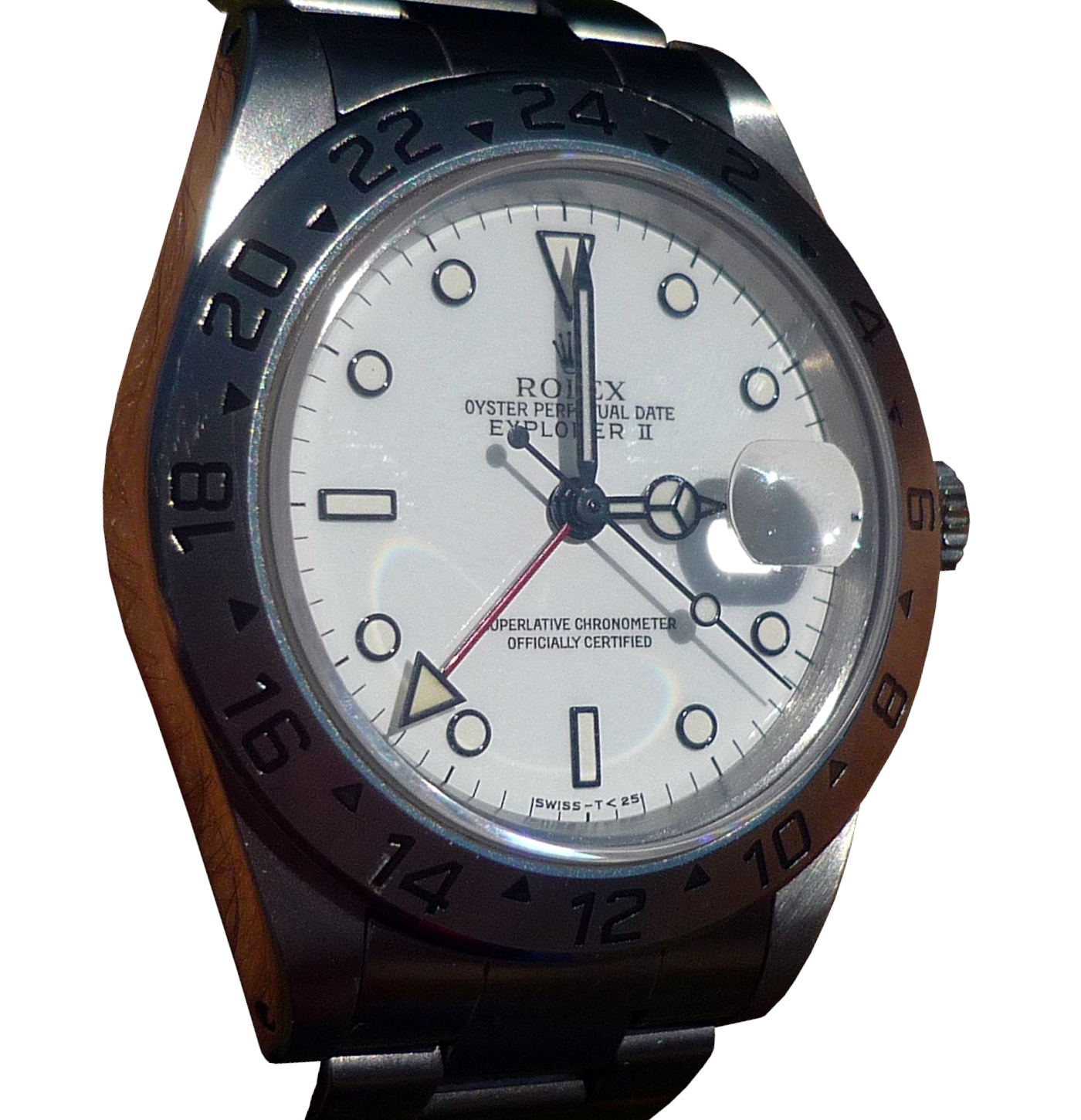
Rolex Explorer II (Polar) Ref. 16570, white dial, steel case
Rolex
Explorer
Rolex GMT-Master II "Root Beer" (two-tone) Ref. 16713, black dial, two-tone case
Rolex
GMT-Master
Medium-large: suits wrists 6.5 in+ (16.5 cm+)
40 mm case. Wears confidently on average to larger wrists. May overhang on slender builds.

Not yet rated

Community + OSINT signals haven’t landed for this reference yet. We don’t publish a rating against zero signal: the number would mean nothing. Editorial body + caliber + market value still surface above; ratings appear once the signal corpus does.

Search pre-owned listings

Chrono24
eBay (sold listings)
WatchBox

Authentication

The 16710 is the last steel GMT before the ceramic-bezel generation and carries strong collector demand. Bezel inserts and bracelets are the most frequently misrepresented components.

Known issues in the market
  • Aluminum bezel inserts fade and crack with age; replacement inserts are common and should be disclosed.
  • The "Pepsi" (blue/red) and "Coke" (black/red) variants command premiums; bezel swaps between variants are occasionally misrepresented.
  • Franken-watches built from period-correct cases with non-matching serials and movements appear at lower price points.
AreaWhat to checkWhat is correctRed flag
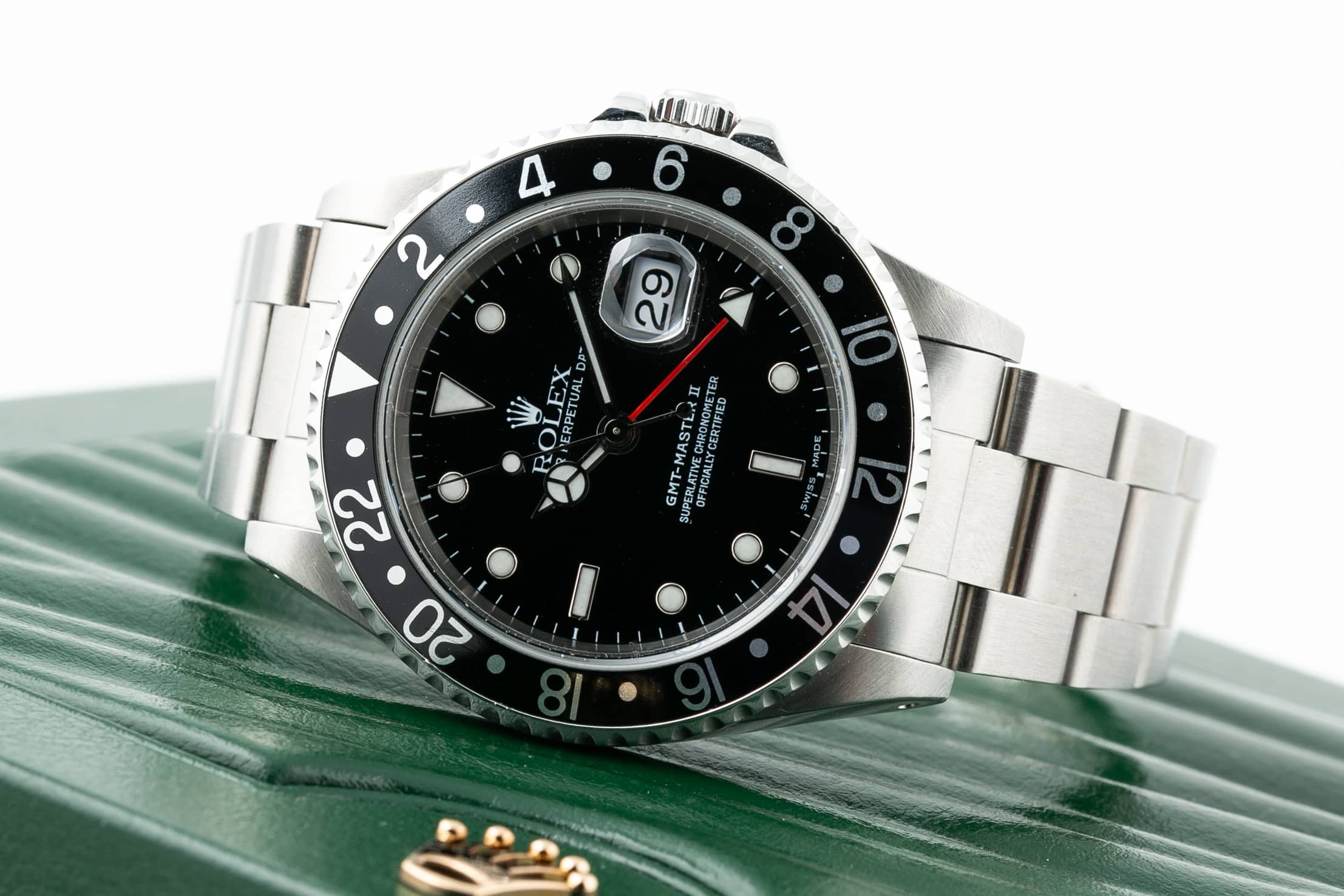
dialGMT arrow hand presence and colorAdditional red GMT hand with arrow tip at 24-hour scale; should track smoothly through 24-hour bezelGMT hand replaced with standard hour hand; incorrect red color or arrow shape
caseOyster Perpetual Date GMTMaster II engraving on case sideText runs along the case midband; crisp and deep consistent engraving in Rolex typefaceShallow engraving; incorrect text; case midband engraving absent
casebackSerial and reference alignment16710 reference between the lugs at 12; serial between lugs at 6; both in period-correct Rolex typefaceSerial number outside the 1989-2007 production range for this reference; inconsistent font
movementCal. 3185 vs. 3186 determinationEarly 16710 uses Cal. 3185; later production upgraded to 3186 with Parachrom hairspring; both are correct depending on serial rangeNon-Rolex movement; Cal. 3135 (no GMT function) in a case stated as GMT
braceletJubilee or Oyster bracelet correctnessOriginal 16710 shipped on Oyster; Jubilee was an option; both are correct; end-link numbers should match bracelet generationEnd-link numbers inconsistent with known 16710 production period; non-Rolex clasp
Common legitimate replacements
  • Aluminum bezel insert replacement after fading or chipping is the most common alteration.
  • Bracelet clasp replacement with later Rolex clasps happens at service; earlier clasps are desirable to some collectors.
  • Crystal replacement is routine; confirm sapphire with correct Rolex cyclops magnifier.
Expert resources: Rolex Forums GMT-Master subforum holds extensive 16710-specific production knowledge including serial ranges. The WatchCSS GMT-Master dial guide maps text variants to production periods. Period Correct Parts publishes known-good aluminum insert color standards.

Authentication guide

Last reviewed June 2026

The 16710 is the last steel GMT-Master II before the ceramic-bezel era and carries strong collector demand. Aluminum bezel inserts fade and are frequently replaced; bracelet end-link matching and movement caliber confirmation are the next priorities.

Known reproduction risks

toggle
HIGH RISK

Franken-watches assembling authentic-era cases with non-matching movement calibers or mismatched bezel inserts from different GMT variants.

  • Serial number range inconsistent with the stated bezel variant (Pepsi inserts were not available throughout the entire production run)
  • Movement without genuine GMT function -- local hour advance that simultaneously moves the GMT hand
  • Case midband engraving depth inconsistent with the rest of the case aging
MEDIUM

Outright replicas targeting the 16710 configuration.

  • GMT hand red color that does not match the red section of the bezel insert in saturation
  • Brushed lug top surfaces that have been polished uniformly, erasing the correct brushing pattern
  • Case midband "GMTMaster II" text in an incorrect font weight or character spacing

Dial variants by era

toggle
EraDescriptionIdentifiers
1989 to 2007 (black, Coke, or Pepsi bezel)Three bezel variants are authentic for this reference: all-black, black-and-red (Coke), and blue-and-red (Pepsi). The dial itself is always black with the red GMT arrow hand.
  • Black dial with white applied hour markers
  • Red arrow GMT hand -- the arrow tip should align precisely with the 24-hour bezel scale
  • "GMTMaster II" text on the case midband in period-correct typeface
  • Date window at 3 o'clock with 2.5x cyclops magnifier
  • Aluminum bezel insert -- ceramic was not used on the 16710

Service part flags

toggle
Bezel insert

Original: Aluminum insert in one of three configurations: all-black, Coke (black upper, red lower), or Pepsi (blue upper, red lower). Original inserts show fading concentrated on the red sections and the pip at 12.

Replacement tells
  • Insert that appears too fresh on an aged case with worn bracelet and crown
  • Color saturation on the red sections that is brighter than on authenticated examples of similar age
  • Pip that has been re-inked to restore color depth
  • Ceramic insert -- never correct for the 16710; ceramic was introduced only with the 116710 successor
GMT hand

Original: Red arrow GMT hand that tracks the 24-hour bezel independently. The hand must be set by rotating the bezel while the local hour hand is adjusted in one-hour increments at crown position 2.

Replacement tells
  • GMT hand replaced with a standard blue or black hour hand -- incorrect color and profile
  • Arrow tip with incorrect proportions that does not track the 24-hour scale cleanly
  • GMT hand lume plot color inconsistent with the dial indices (both should match in material generation)
Bracelet

Original: Oyster bracelet is standard; Jubilee was an option. End-link reference numbers should match the known production period for the 16710. Clasp uses two-letter date code on the inner clasp arm.

Replacement tells
  • End-link numbers inconsistent with known 16710 production period (1989 to 2007)
  • Later-generation Oyster bracelet from the 116710 with different link dimensions
  • Clasp without a two-letter date code, or with a code that places manufacture outside the 16710 production window

Case back markings

toggle
1989 to 2007
  • Solid caseback -- no exhibition window
  • "ROLEX OYSTER PERPETUAL DATE GMTMaster II" engraved in the outer ring (note the spacing pattern)
  • Serial engraved between the lugs at 6
  • Reference 16710 engraved between the lugs at 12
  • Serials in the R through Y range cover the majority of production

Movement tells

toggle
  • Early 16710 examples use Cal. 3185; later production (approximately Y-serial onward) upgraded to Cal. 3186 with a Parachrom hairspring. Both are correct depending on serial range.
  • Cal. 3186 Parachrom hairspring appears blue-violet when viewed from the balance side; the earlier 3185 uses a standard alloy spring.
  • The independent local-hour function: advancing the local hour hand must not stop the seconds hand. If seconds freeze during local-hour adjustment, the movement has been swapped for a standard two-hand GMT without the quick-set.
  • Cal. 3135 (non-GMT) placed in a 16710 case is a documented movement swap -- if the second crown position adjusts the local hour with no GMT function, suspect a Cal. 3135.
Sources: Rolex Forums -- GMT-Master subforum, 16710 production and authentication threads; WatchCSS -- GMT-Master dial and text variant guide; Period Correct Parts -- aluminum insert color standard documentation.

You might also like

Rolex GMT-Master II "Root Beer" (two-tone) Ref. 16713, black dial, two-tone case
Rolex
GMT-Master
Ref. 16713
Rolex GMT-Master II "Pepsi" (Cerachrom) Ref. 126710BLRO, black dial, steel case
Rolex
GMT-Master
Ref. 126710BLRO
Rolex GMT-Master II "Coke" (Vintage Steel) Ref. 16700, black dial, steel case
Rolex
GMT-Master
Ref. 16700
Rolex
GMT-Master
Ref. 126710BLNR
Rolex
GMT-Master
Ref. 126720VTNR
Rolex Explorer II (Polar) Ref. 16570, white dial, steel case
Rolex
Explorer
Ref. 16570

Buying guidance

← Back to Grail Atlas