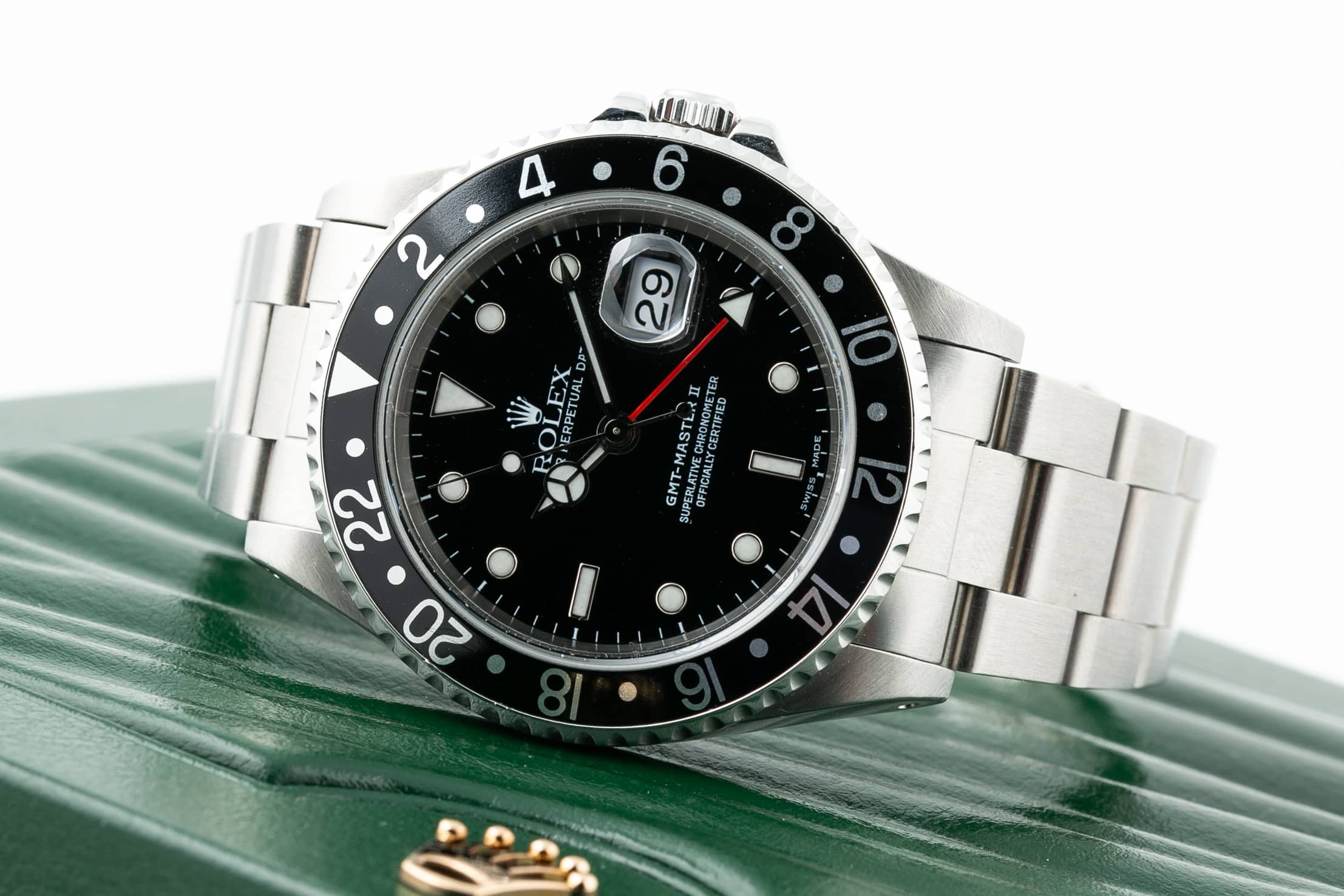
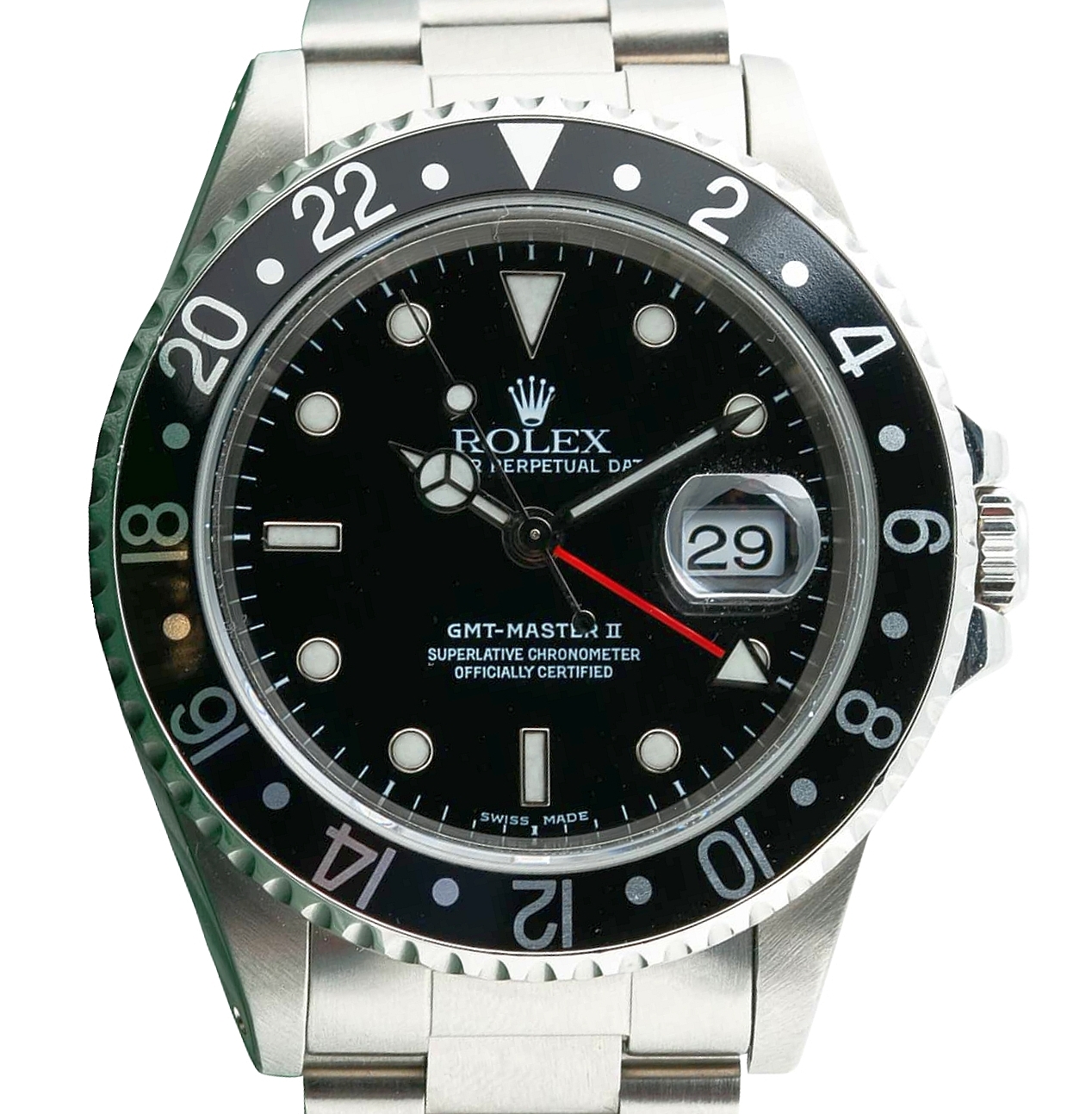
Last GMT-Master II with an independently adjustable 24-hour hand before the current 126710; the "LNIB" market for this reference is strong.
Originality
Originality matters on this reference. An original dial and hands command a significant premium. Service replacements typically trade at a 20-40% discount to original examples.
Dial variants
- Red/blue anodized aluminum bezel insert
- Flat matte black dial with thin tritium plots
- SWISS T<25 or Swiss Made underprint
- Fat font vs later thin-font dials
Early 16710 Pepsi examples with matte dials are harder to find in honest condition than the later glossy versions. Collectors prize the matte surface for its tie to the vintage 1675.
- Black/red anodized aluminum bezel insert
- Glossy lacquered black dial
- Superluminova plots replacing tritium
- Thin-font dial printing
The late-production 16710 with Coke bezel and glossy dial is the most common configuration. It is a straightforward buy with no dial-specific premiums or pitfalls beyond the usual bezel fade concerns.
Live pricing is coming soon. Get notified when it is available for this reference.
Also uses Rolex Cal. 3185

Not yet rated
Community + OSINT signals haven’t landed for this reference yet. We don’t publish a rating against zero signal: the number would mean nothing. Editorial body + caliber + market value still surface above; ratings appear once the signal corpus does.
Search pre-owned listings
Authentication
The 16710 is the last steel GMT before the ceramic-bezel generation and carries strong collector demand. Bezel inserts and bracelets are the most frequently misrepresented components.
- Aluminum bezel inserts fade and crack with age; replacement inserts are common and should be disclosed.
- The "Pepsi" (blue/red) and "Coke" (black/red) variants command premiums; bezel swaps between variants are occasionally misrepresented.
- Franken-watches built from period-correct cases with non-matching serials and movements appear at lower price points.
| Area | What to check | What is correct | Red flag |
|---|---|---|---|
| dial | GMT arrow hand presence and color | Additional red GMT hand with arrow tip at 24-hour scale; should track smoothly through 24-hour bezel | GMT hand replaced with standard hour hand; incorrect red color or arrow shape |
| case | Oyster Perpetual Date GMTMaster II engraving on case side | Text runs along the case midband; crisp and deep consistent engraving in Rolex typeface | Shallow engraving; incorrect text; case midband engraving absent |
| caseback | Serial and reference alignment | 16710 reference between the lugs at 12; serial between lugs at 6; both in period-correct Rolex typeface | Serial number outside the 1989-2007 production range for this reference; inconsistent font |
| movement | Cal. 3185 vs. 3186 determination | Early 16710 uses Cal. 3185; later production upgraded to 3186 with Parachrom hairspring; both are correct depending on serial range | Non-Rolex movement; Cal. 3135 (no GMT function) in a case stated as GMT |
| bracelet | Jubilee or Oyster bracelet correctness | Original 16710 shipped on Oyster; Jubilee was an option; both are correct; end-link numbers should match bracelet generation | End-link numbers inconsistent with known 16710 production period; non-Rolex clasp |
- Aluminum bezel insert replacement after fading or chipping is the most common alteration.
- Bracelet clasp replacement with later Rolex clasps happens at service; earlier clasps are desirable to some collectors.
- Crystal replacement is routine; confirm sapphire with correct Rolex cyclops magnifier.
Authentication guide
The 16710 is the last steel GMT-Master II before the ceramic-bezel era and carries strong collector demand. Aluminum bezel inserts fade and are frequently replaced; bracelet end-link matching and movement caliber confirmation are the next priorities.