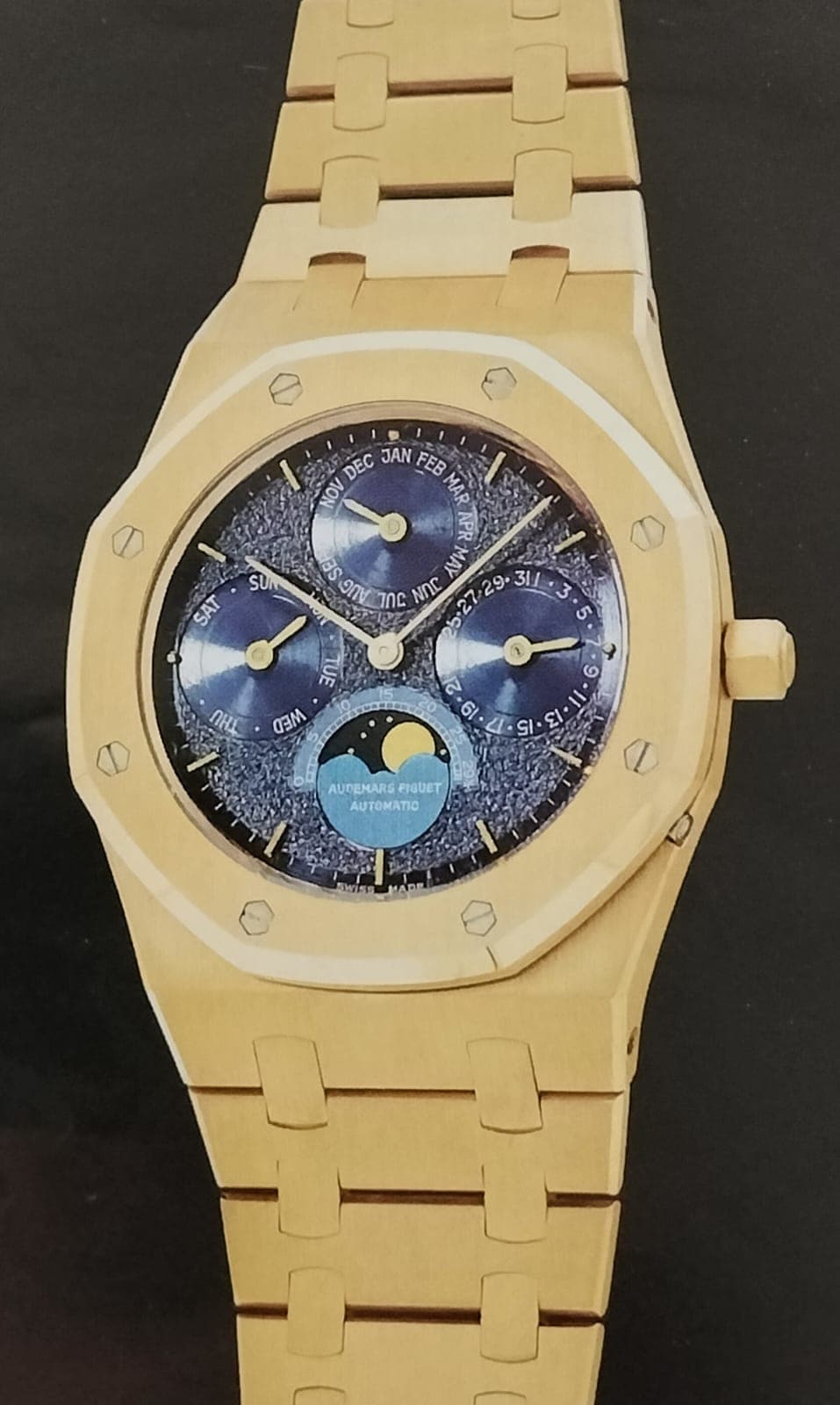
Perpetual calendar
Programs every month length, including leap years, through 2100
A 12-lobe programming cam encodes every month length; the date disc advances in 31 steps over each calendar month.
What it is
The perpetual calendar is a mechanical calendar mechanism that automatically advances the date, day, month, and leap-year indicator for every month and year in the Gregorian calendar, including February in leap years. No manual correction is required under normal operation until 2100, when the Gregorian rule that century years are not leap years (unless divisible by 400) means the watch will need one correction on March 1, 2100.
History
Perpetual calendar mechanisms appeared in pocket watches from the late 18th century. In wristwatches, Patek Philippe's reference 3940 (1985) set the modern standard: a slim integrated perpetual calendar with moonphase. The 5140 (2001), 5170 (manual-wind with chronograph), and the celestial 5102 are subsequent benchmarks. A. Lange & Söhne's Langematik Perpetual (2001) was the first perpetual calendar wristwatch with a push-button simultaneous forward-correction for all displays at once; previously, correcting after a battery change or long stop required advancing each display separately in sequence.
How it works
A four-year (leap-year) cam drives a 48-month or equivalent programming mechanism that encodes the length of every month in the Gregorian calendar. At month-end, the mechanism advances the date, month, and leap-year indicator simultaneously to the correct values for the following month. The 2100 exception: 2100 is divisible by 4 but is not a leap year under Gregorian rules, so perpetual calendars programmed on a simple 4-year cycle will require one correction on March 1, 2100.
Parts required
Leap-year cam (4-year cycle), 12-month programming cam, day-of-week wheel, month wheel, date jumper and corrector, all driven by a dedicated motion-works wheel train
What makes it difficult
Encoding all Gregorian calendar rules into a purely mechanical cam system requires extremely precise cam profiles. The mechanism must advance multiple displays; day, date, month, and sometimes a leap-year indicator; simultaneously at midnight at month-end without any display jumping or jamming. Any single component failure can cause the entire calendar to skip or misalign. The correcting sequence (for use after a long stop) must be performed in a specific order on most movements, as attempting corrections in the wrong order can damage the mechanism.
In the catalog
Related
- Date: The most common watch complication; and the most corrected
- Annual calendar: Knows 30- vs. 31-day months; needs one correction per year
- Moonphase: A display of the current lunar phase