Annual calendar
Knows 30- vs. 31-day months; needs one correction per year
What it is
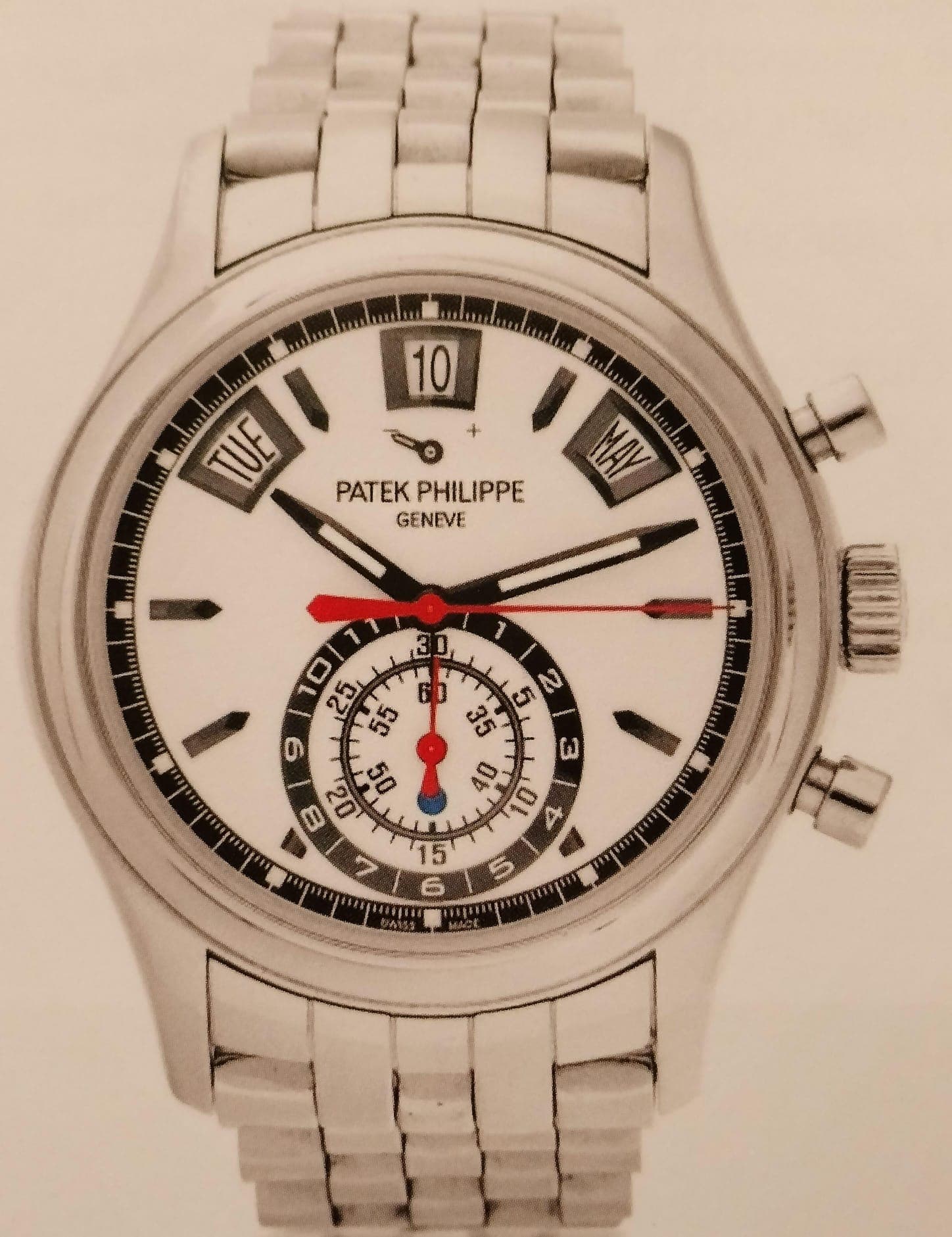
The annual calendar distinguishes between 30-day and 31-day months, advancing the date display automatically at the end of each. It requires only one manual correction per year, at the end of February, because it cannot account for February's 28 or 29 days. This places it between the simple date (5–7 corrections per year) and the perpetual calendar (no corrections until 2100) in both complication and price.
History
Patek Philippe introduced the annual calendar in 1996 with reference 5035, calling it the complication between a simple date and a perpetual calendar. It was immediately recognised as a practical proposition for everyday wear: one correction per year is easy to remember, and the mechanism is significantly less complex than a perpetual calendar. IWC, A. Lange & Söhne, and other manufactures followed with their own annual calendar implementations. The Patek 5396 (2006) became the most produced and collected annual calendar reference.
How it works
A programming cam with distinct lobes for 30-day and 31-day months controls whether the mechanism skips the 31st position at month-end. As each month expires, the cam allows the date to advance normally or jumps it from the 30th to the 1st directly. The cam cannot distinguish February (28 or 29 days) from the 30-day months, so the February correction is still manual; typically performed with the date corrector pushed on March 1st.
Parts required
Programming cam (12-month, with 30-day and 31-day lobes), additional date-driving lever, month-sensing finger, month disc
What makes it difficult
The programming cam must carry precise lobes for all 12 months across the two month-length categories. The mechanism must reliably distinguish 30-day from 31-day months without operator intervention for every month of the year except February. Encoding this reliably in a purely mechanical system while keeping the movement slim enough for a dress or sport watch requires careful cam geometry and spring tuning.
In the catalog
Related
- Date: The most common watch complication; and the most corrected
- Perpetual calendar: Programs every month length, including leap years, through 2100