Down 15% over the past 90 days
Based on eBay sales, last 12 months
Pre-owned watches trade across a wide condition spectrum. These ranges are typical for the secondary market.
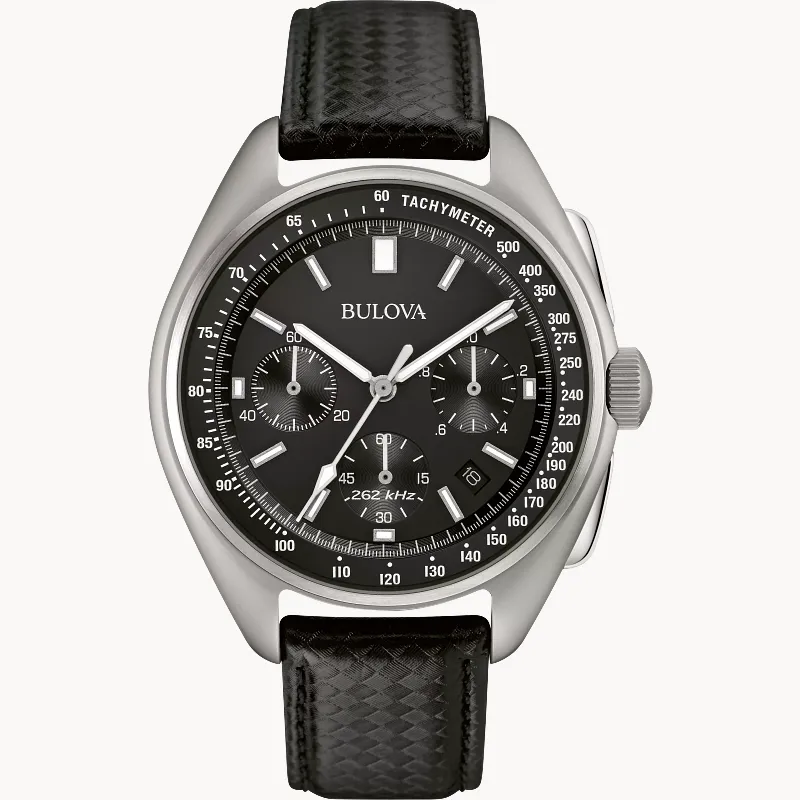
The Bulova Lunar Pilot is the modern tribute to the watch Dave Scott wore on the lunar surface during Apollo 15 in August 1971 - a Bulova 214 Accutron (tuning fork) chronograph that Scott wore strapped to his suit cuff. The modern reissue uses a high-frequency Sellita SW510M movement at 262Hz (far beyond the standard 3-8Hz range), giving it exceptional accuracy and a distinctly rapid seconds hand sweep.
The original Bulova 214 Accutron used a tuning-fork mechanism, not a traditional balance wheel. NASA approved it for the mission as a backup chronograph. The modern Lunar Pilot (ref. 96B258) reissues the design with a Swiss mechanical movement from Sellita, making it catalog-eligible as a mechanical watch.
Released 2014 onwards. The 45mm case with crown at 4 o'clock and the tachymeter bezel match the original.
The movement's high frequency (262Hz vs typical 28,800bph Swiss) means service intervals differ from most mechanical watches. Not all watchmakers are familiar with servicing it - Bulova service centers are preferred. The original Accutron was a tuning-fork watch (not truly mechanical); buyers attracted by the Apollo connection should understand the modern reissue is a mechanical tribute, not the Accutron technology.
Strong enthusiasm from space/NASA collectors but limited crossover into serious horology. Prices hover in the $400-700 range new, with used examples often under $300. The high-beat movement is genuinely unusual for the price point.
Bulova recommends service every 5-7 years. The high-frequency movement generates more heat and wears faster than conventional movements if neglected. Find a watchmaker familiar with Sellita service rather than a generalist.
Community + OSINT signals haven’t landed for this reference yet. We don’t publish a rating against zero signal — the number would mean nothing. Editorial body + caliber + market value still surface above; ratings appear once the signal corpus does.
The 262Hz ultra-high frequency movement gives the seconds hand a continuous sweep; any Lunar Pilot where the seconds hand ticks has a standard-frequency movement swap.
| Area | What to check | What is correct | Red flag |
|---|---|---|---|
| movement | Ultra-high frequency seconds sweep | Seconds hand sweeps continuously at 262Hz; no visible tick steps | Seconds hand ticks in visible steps; standard-frequency movement swap |
| dial | "LUNAR PILOT" text on dial | "LUNAR PILOT" text present on dial | Missing "LUNAR PILOT" text; wrong reference or non-genuine dial |
| crown | Manual-wind chronograph pushers | Both pushers engage cleanly; start/stop/reset functions operate correctly | Sticky or non-returning pusher; chronograph mechanism requires service |
The Lunar Pilot is an officially licensed NASA watch: astronaut Dave Scott wore a Bulova on the lunar surface during Apollo 15. The 2019 reissue uses the Bulova high-frequency movement derived from the Accutron tuning fork concept. The seconds hand sweeps as a continuous motion, not steps, due to the 262kHz oscillator. This smooth sweep is the fastest authentication check.

| Identifiers |
|---|
| 2019 to present | Silver panda dial with three chronograph registers: small seconds at 9, 30-minute counter at 3, 12-hour counter at 6. Arabic numerals. Chronograph pushers at 2 and 4. Tachymeter bezel. 45mm steel case. |
|