
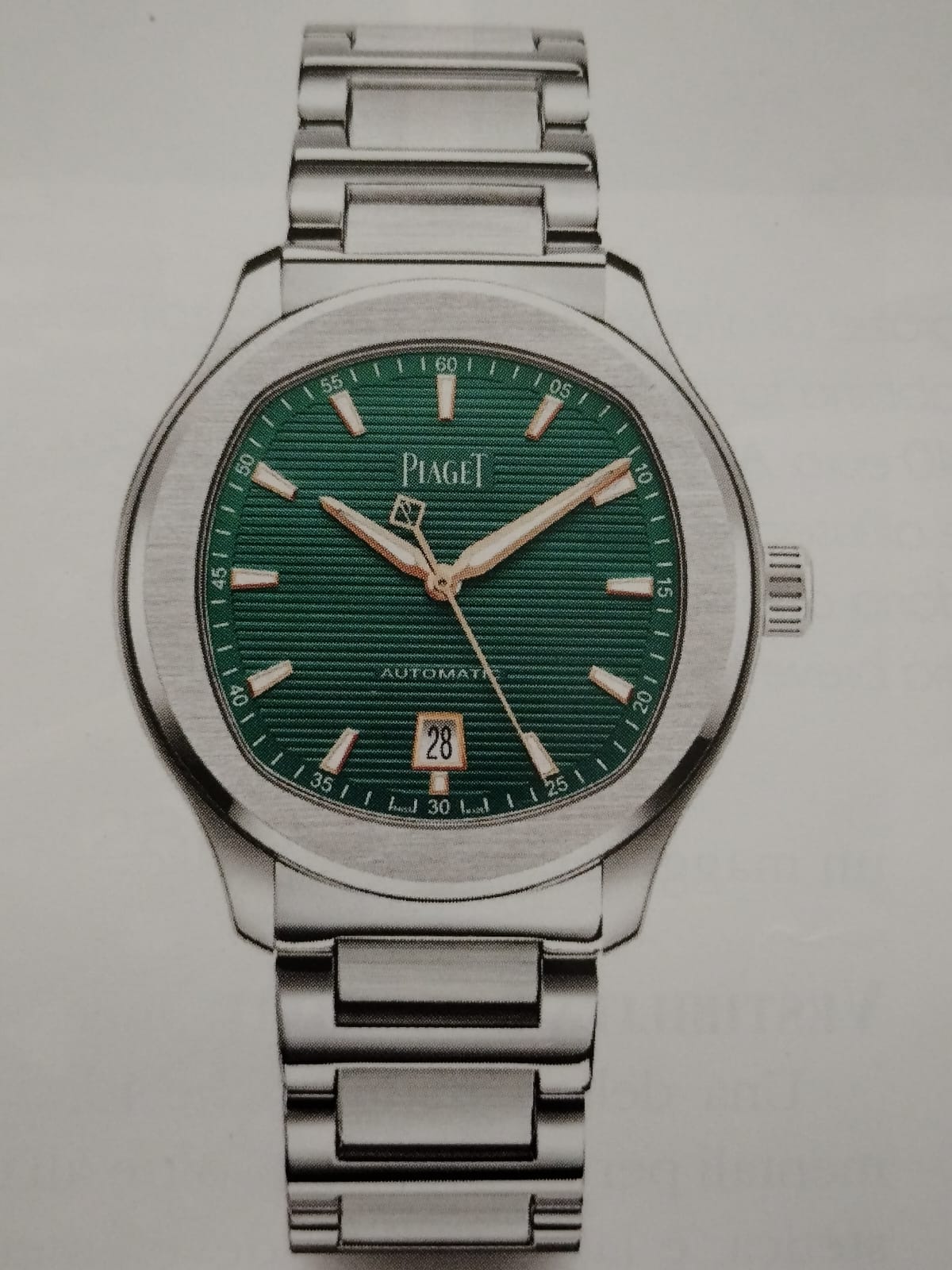
The Piaget Polo | family history
The Piaget Polo (1979) was the brand's entry into the integrated-bracelet luxury sport category, following the Royal Oak (1972) and Nautilus (1976). Piaget's interpretation was softer: a rounded-corner rectangular case with an unusual ladder-link bracelet that gives the vintage Polo a distinctive wrist presence that neither the Royal Oak nor the Nautilus replicates. The vintage 1979-1983 Polo references, particularly the ultra-thin quartz and mechanical versions in gold, have become significant secondary-market collector pieces among buyers who track that era.
Piaget's sport-elegance integrated-bracelet family, first introduced in 1979 with a distinctive H-link bracelet. The Polo S (2016) revived the family in steel with an in-house caliber and a case that successfully occupies the sport-elegance gap (smooth, integrated, not angular) at a price substantially below Royal Oak or Nautilus. Available in 42 mm automatic and skeleton variants.
1979–1990 · The original Polo
The original Piaget Polo launched in 1979 as a jewelry-sport hybrid: an integrated bracelet, thin case, rounded-rectangular geometry, and Piaget's commitment to precious metal and ultra-thin movements. The vintage Polo in gold with ultra-thin mechanical or quartz movements is the collector reference: the distinctive ladder-link bracelet, the soft corners, and the Piaget family's jewelry heritage gave it a character that was different from the Genta-derived competition. Vintage Polo references in gold trade actively in the secondary market.
No references from this era in the catalog yet.
1990–2015 · Hiatus and reformulation
The Polo line went through reformulations and periods of reduced production through the 1990s and 2000s. The Polo FortyFive (2009) was a larger, more aggressive 45mm sport watch that departed from the original's jewelry-sport character. It did not become a collector reference.
No references from this era in the catalog yet.
2016–present · The Polo S and Polo Date
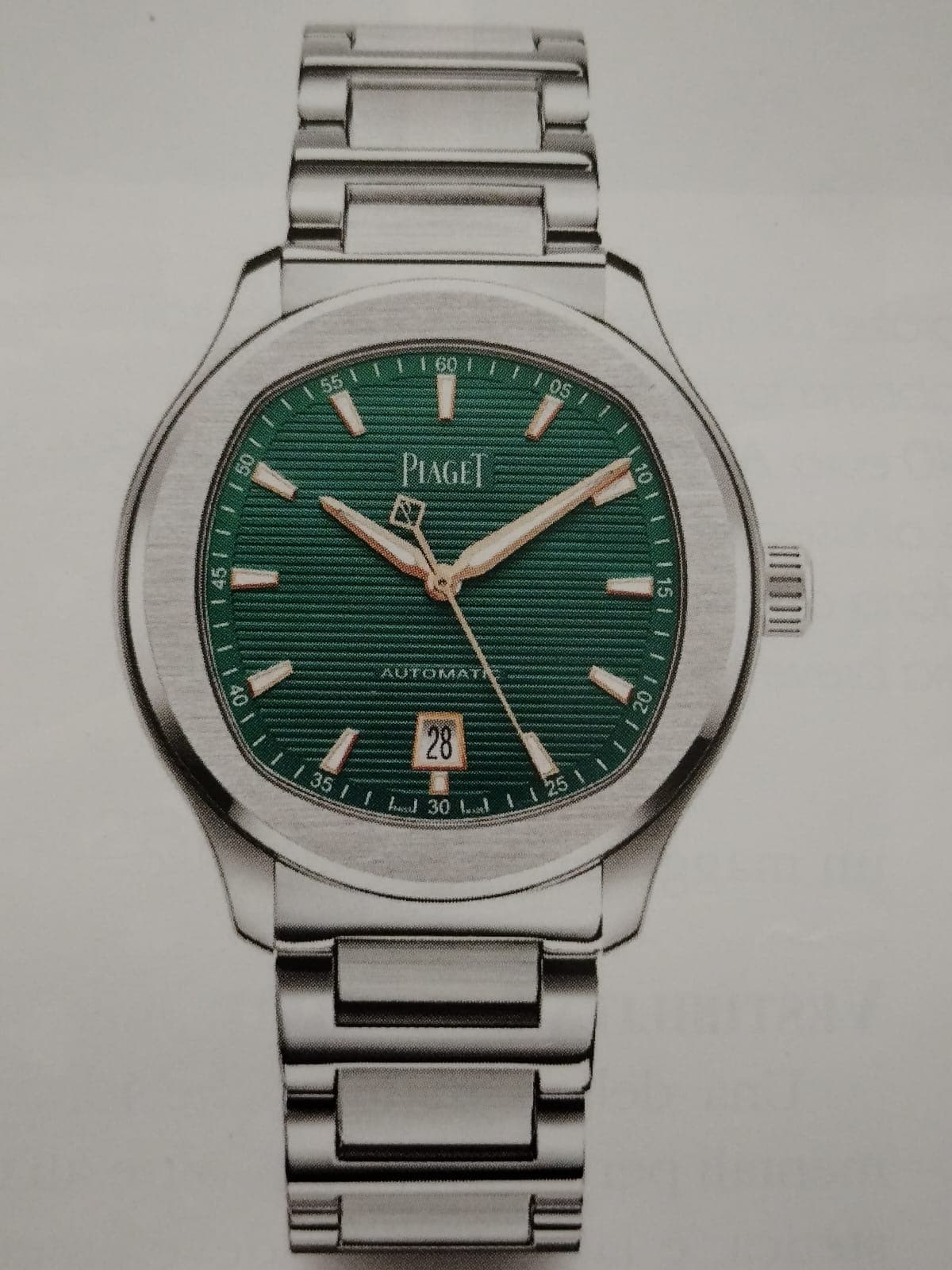
The modern Polo S (2016) and Polo Date (2019) revived the integrated-bracelet sport watch in a 42mm steel case, with the in-house 1160P automatic caliber. The Polo S is the time-only reference; the Polo S Chronograph adds the timing function. The modern Polo reads differently from the vintage: the case is rounder and more contemporary, the bracelet less distinctive than the original ladder-link. The modern references are quality sport watches with genuine Piaget manufacture calibers; they have not yet attracted the vintage Polo's collector narrative.
How to read this family
Three honest questions for any Polo buyer:
- Vintage Polo or modern Polo S: completely different purchases The vintage Polo (1979-1983) in gold is a collector piece with an established secondary-market trajectory. The modern Polo S is a current-production sport watch in steel with a manufacture automatic. These are not the same purchase in any meaningful sense. Be clear which you are considering.
- Modern Polo S versus Royal Oak or Nautilus at a similar price? The Royal Oak and Nautilus trade at premiums that reflect their collector status and artificial scarcity. The Polo S trades at or near retail without the secondary-market premium. For a buyer who wants to wear a manufacture Swiss sport watch without paying a collector premium, the Polo S is a rational alternative. It does not carry the same prestige signal.
- Is Piaget's in-house caliber in the Polo S a genuine manufacture movement? The 1160P in the modern Polo S is Piaget's in-house automatic caliber. Piaget has been producing movements in La Cote-aux-Fees since the 1940s. The manufacture credentials are real and not recent. The 1160P has a 50-hour power reserve and is appropriately finished for the price tier.
Related families: Piaget Altiplano · Royal Oak
References in this family
Which ref to buy
The Polo is Piaget's integrated-bracelet sport line -- thinner than anything Audemars or Patek makes in the category, with in-house movements engineered specifically for the slim case architecture. The family sits in an odd market position: not a Nautilus, not an Aquanaut, but arguably the most technically accomplished thin sport watch available.
- 1Open
Polo S Automatic 42mm with cal. 1160P -- the correct entry into the family and the thinnest integrated-bracelet sport watch at this case size.
- The case for it:
- Cal. 1160P uses a peripheral rotor winding system that keeps the movement at 3.7mm -- no other automatic 42mm sport watch comes close to this case height. For buyers who care about how thin a watch sits on the wrist, there is no competition.
- Consider instead if:
- The Polo Date offers a more modern dial layout with a cleaner date implementation and slightly slimmer overall case height via the 1110P. If you wear it with a suit daily, the Date version is the sharper choice.
- 2Open
Polo Date 42mm with cal. 1110P -- slim sport watch with a considered date complication and three dial color options.
- The case for it:
- The 1110P brings the case height to 9mm flat -- trimmer than the Polo S Auto -- and the date window is sized correctly for the dial. Three dial colors (silver, blue, black) give genuine choice without compromising the design.
- Consider instead if:
- The Polo S Auto has the more distinctive peripheral-rotor story and a longer production history. If you are going to explain what makes the watch interesting to anyone who asks, the 1160P is the better conversation.
- 3Open
Polo Skeleton 42mm with cal. 1200S manual-wind skeletonized movement -- for buyers who want the Polo architecture with the movement exposed.
- The case for it:
- Manual-wind skeletonized movement in a thin sport case is a genuinely unusual combination. The 1200S is finished to a level that holds up when the dial is stripped away. This is the ref that proves Piaget knows how to finish.
- Consider instead if:
- Skeletonization is a polarizing aesthetic and the manual-wind discipline requires daily winding. If you want the Polo for daily wear without ceremony, the automatic versions are the correct choice.
- 4Open
Polo S Chronograph 42mm -- column-wheel chronograph in a thin integrated case, technically impressive but a niche choice within the family.
- The case for it:
- A column-wheel integrated chronograph at 12.1mm case height is a real engineering achievement. If you need a chronograph and thin is the priority, there is nothing else like this.
- Consider instead if:
- The chronograph case is noticeably thicker than the automatic refs and loses the key Polo proposition -- the extreme thinness. Most buyers choosing the Polo are doing so for that thinness. The automatic refs stay truer to why the family exists.
Rankings last reviewed 2026-06-07. Editorial perspective only. Not financial advice.