

The Blancpain Fifty Fathoms | family history
The Fifty Fathoms predates or matches the Rolex Submariner depending on who is counting. Blancpain's diving watch was developed by Jean-Jacques Fiechter, an amateur diver who became Blancpain's CEO in 1950 and wanted a serious wrist-worn dive instrument. The first Fifty Fathoms was introduced in 1953 and adopted by the French Navy. The Submariner reached market the same year, also targeting professional military divers. Where the Submariner became the cultural archetype of the dive watch, the Fifty Fathoms became the technical reference. The modern Fifty Fathoms Automatique runs a five-day movement architecture with three barrels and a silicon anti-shock spring; the 1315 caliber is one of the most technically accomplished dive-watch movements in current production.
Released in 1953, the same year as the Submariner, as the dive watch the French Combat Swimmers had specified. Unidirectional bezel, anti-magnetic case, locking crown: the spec sheet every modern dive watch is built against. The Bathyscaphe is the smaller, contemporary sub-line.
1953–1960s · The original Fifty Fathoms: French Navy adoption
Blancpain's Jean-Jacques Fiechter developed the Fifty Fathoms as a professional dive instrument from 1950, with Rolf Stadler and other engineers, and a first production run in 1953. The French Navy's combat divers (Nageurs de Combat) adopted it. Key features: rotating bezel locked against accidental movement, luminous dial for underwater legibility, 50-fathom (91.4m) water resistance. The canvas strap replaced the metal bracelet for diving use. These original references are in the five-to-six-figure collector market; the provenance and the technical argument are both strong.
No references from this era in the catalog yet.
2003–2007 · The modern reissue and the Automatique
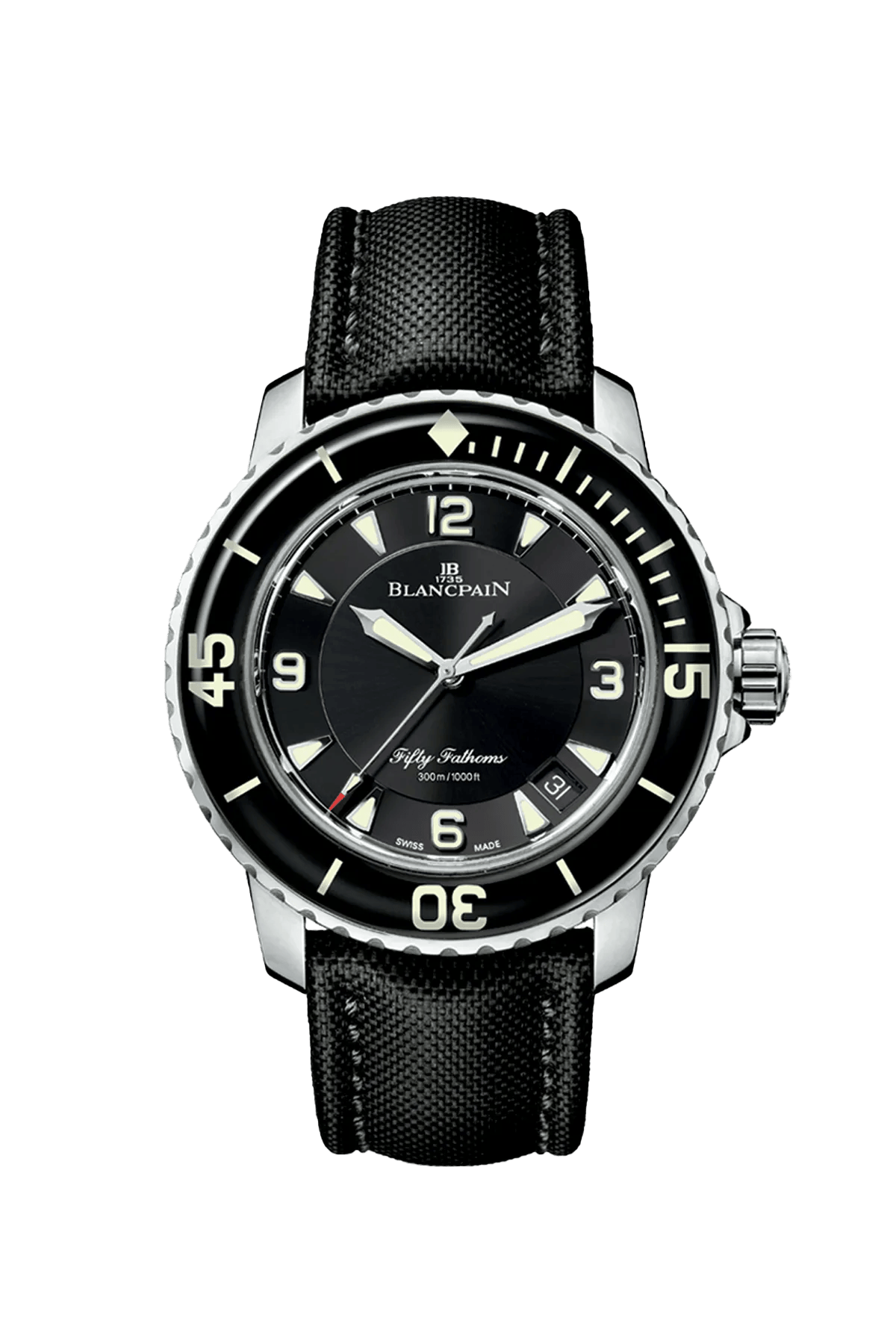
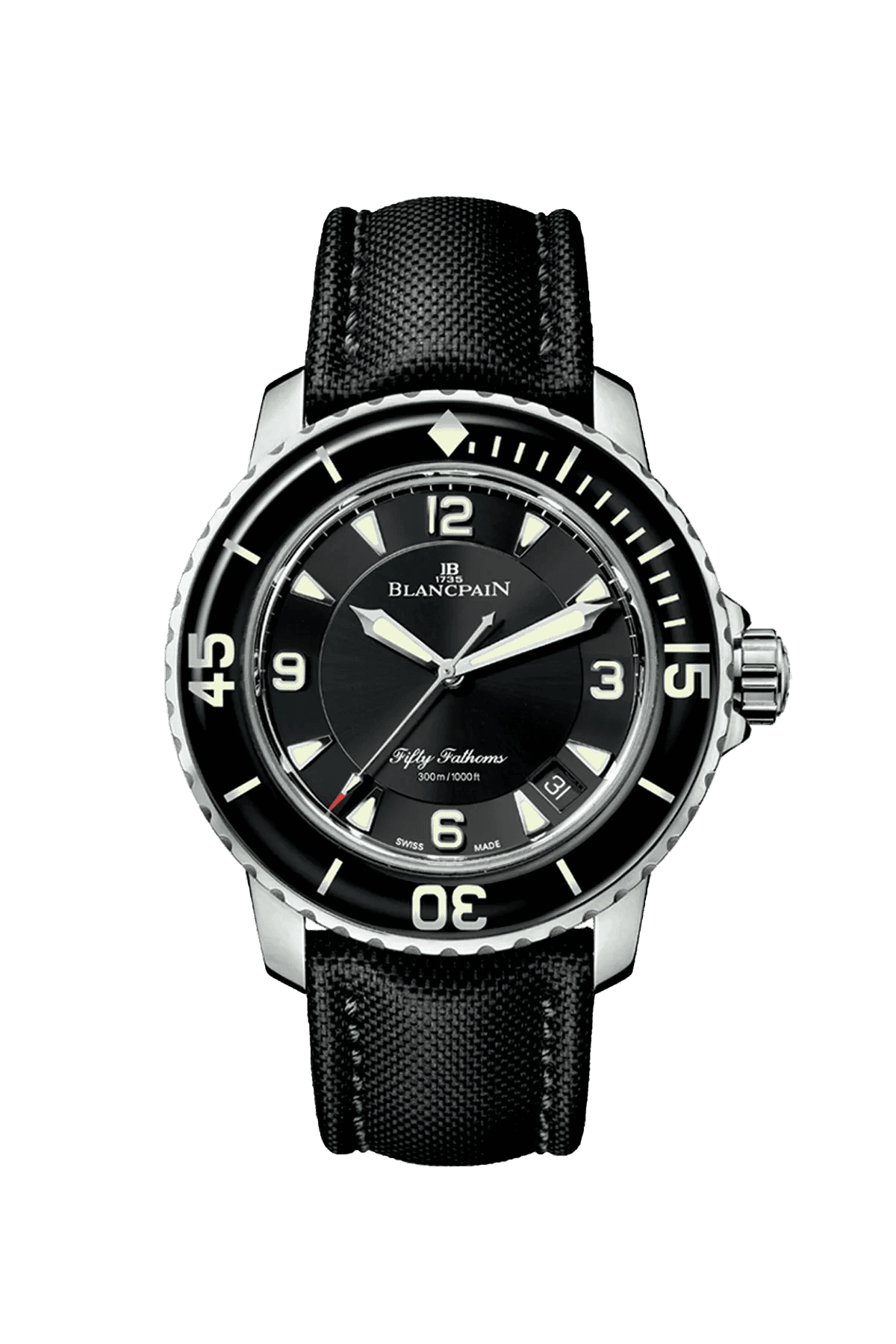
Blancpain reissued the Fifty Fathoms in 2003 with a 45mm case and updated movement. The 2007 Automatique (ref. 5015-1130-52) is the anchor of the modern line: caliber 1315, three-barrel five-day reserve, monodirectional winding, silicon anti-shock spring on the balance staff, sapphire-topped bezel. 45mm is genuinely large on most wrists; the Fifty Fathoms has always been sized for working divers rather than for general wear. The 2007 Automatique is the canonical modern Fifty Fathoms; it trades well on the secondary market and is available at retail at most Blancpain boutiques.
- OpenThe Fifty Fathoms Automatique is the civilian production descendant of the 1953 reference co-developed with the French Navy, making it one of the few current dive watches with an unbroken specification lineage to the original professional tool.
2013–present · The Bathyscaphe: ceramic bezel, 43mm, more accessible
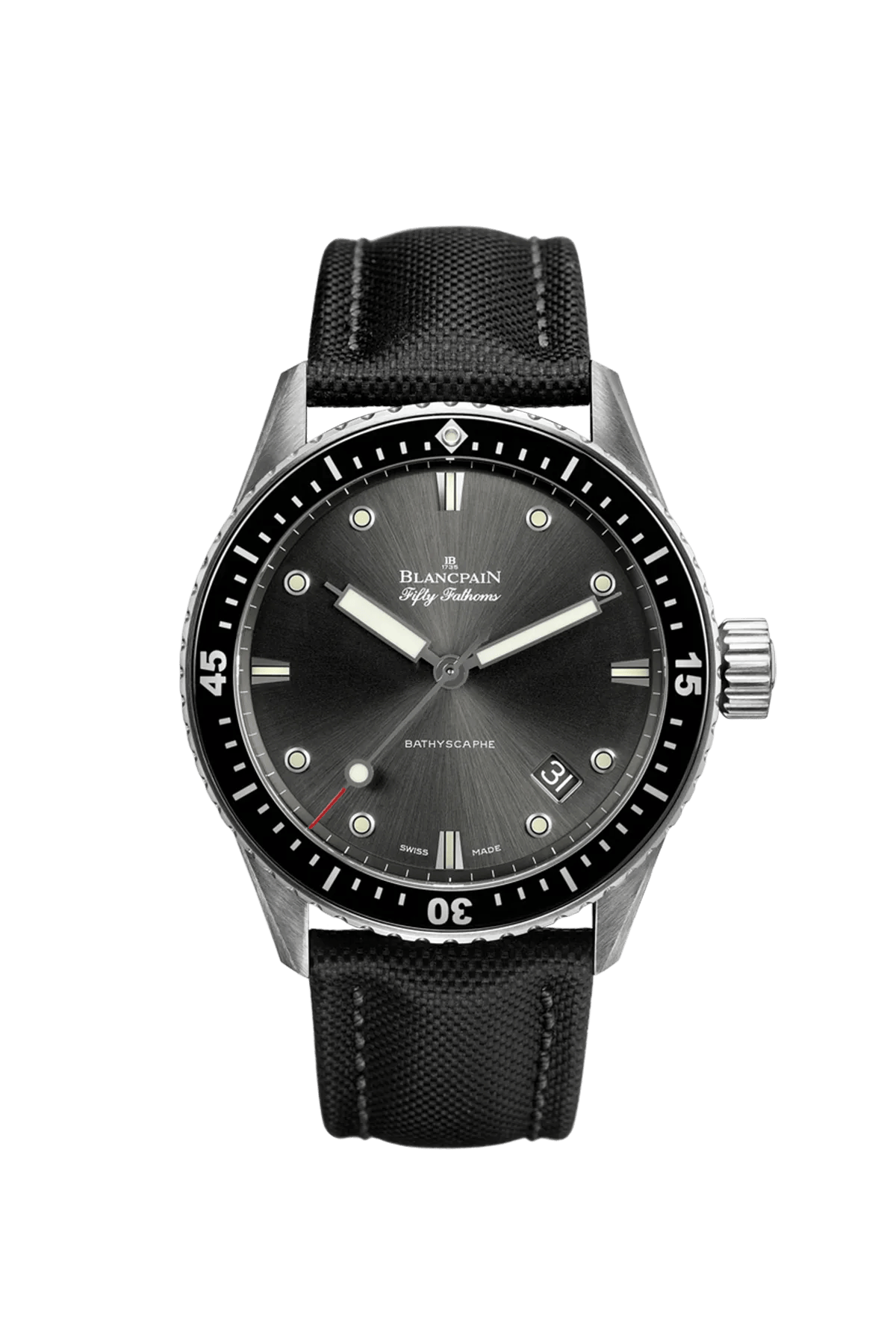
Blancpain launched the Bathyscaphe (5000-1110-B52A, 2013) as the more wearable Fifty Fathoms: 43mm vs 45mm, ceramic bezel rather than sapphire, same caliber 1315 inside. The Bathyscaphe name comes from the Picard deep-sea vessel; it is the Fifty Fathoms for buyers who find 45mm too large for daily wear without a diving context. Blue or black dial, rubber or NATO strap. It has become the most-sold Fifty Fathoms variant in the modern era.
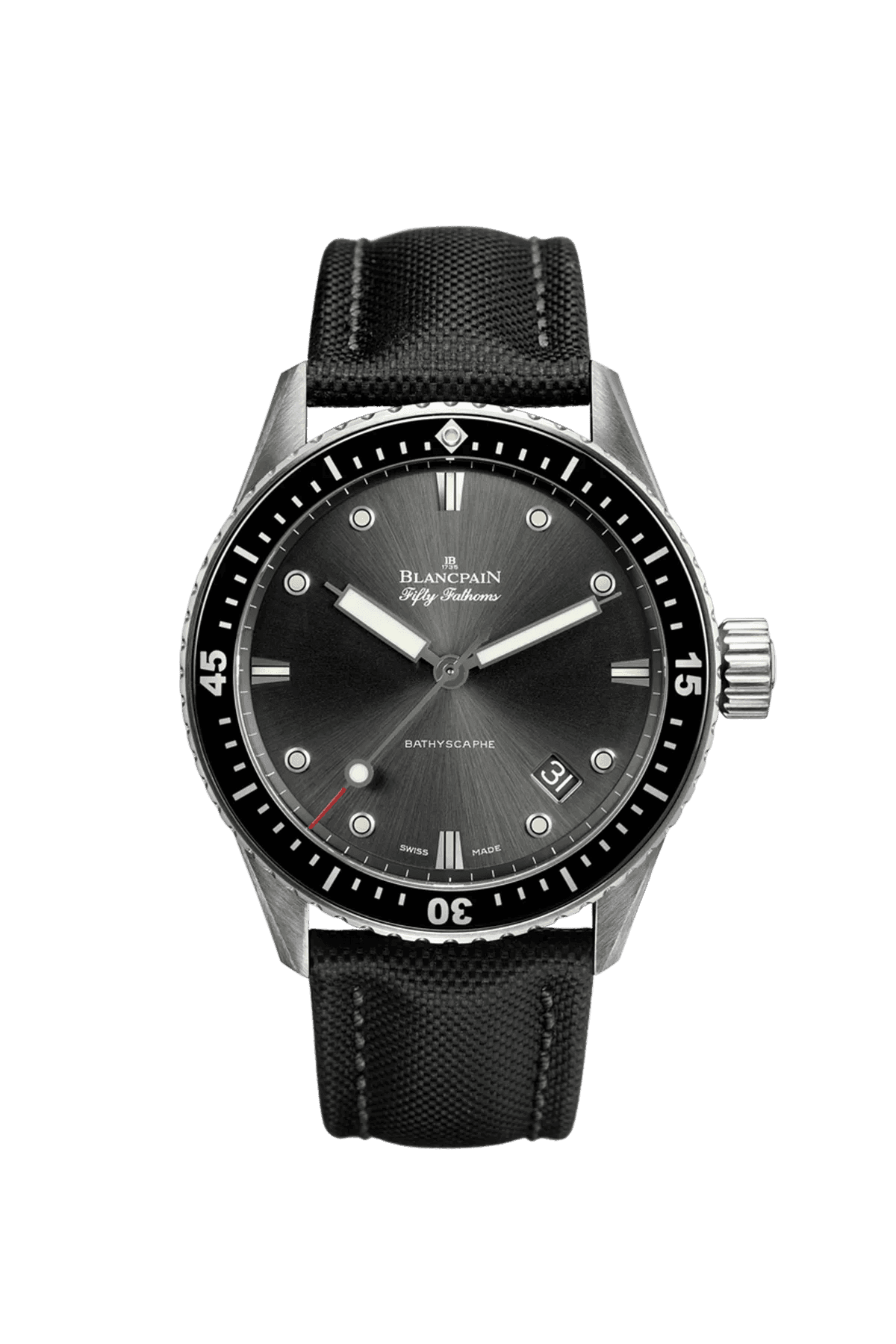
2012–present · The Aqua Lung / Aqucos: the compact variant
The 38mm Aqucos (5050-1110-NABA, 2012) is the smallest Fifty Fathoms in current production, with a ceramic bezel and the same caliber 1315. It exists for buyers who want the Fifty Fathoms mechanics in a case that fits smaller wrists. The 38mm case makes it the most wearable Fifty Fathoms as a daily watch outside a diving context.

How to read this family
Three honest questions for any Fifty Fathoms buyer:
- Automatique (45mm), Bathyscaphe (43mm), or Aqucos (38mm)? The Automatique is the large traditional version with sapphire-topped bezel and the most direct connection to the original 1953 proportions. The Bathyscaphe is the more contemporary daily-wear option with ceramic bezel at 43mm; it is what most Fifty Fathoms buyers end up with. The Aqucos at 38mm is for buyers who need the size down. For most buyers, Bathyscaphe is the correct starting point; try the Automatique if you genuinely wear 45mm comfortably.
- Sapphire or ceramic bezel? The Automatique's bezel insert is domed sapphire over the scale: glossy, deep, and scratch-resistant, a signature Blancpain choice rather than the aluminum of vintage tool divers. The Bathyscaphe's ceramic bezel is the flatter, more contemporary treatment. Both resist scratches far better than vintage aluminum; the choice is aesthetic: the sapphire reads dressier and more traditional, the ceramic more matte and modern. For a watch you plan to actually dive with, either is practical.
- Fifty Fathoms or Submariner? The honest comparison: the Fifty Fathoms has a technically better movement (caliber 1315 vs Rolex 3235; the five-day reserve and silicon anti-shock spring are genuine advantages), is available at retail, and costs less than the Submariner on the secondary market. The Submariner has higher brand recognition and stronger secondary-market liquidity. If you want the better tool watch, Fifty Fathoms. If you want the more liquid asset, Submariner. These are not the same question.
Related families: Submariner · Black Bay · Seamaster
Sub-lines
- OpenThe Fifty Fathoms Aqucos (AquaLung Combat Swimmer), recreating the original 1953 watch issued to the French Navy's combat divers. The watch that started the modern dive watch category, reissued with the original specifications including the luminous radiation-symbol dial marker and the non-ratcheting internal bezel.
- OpenThe 45mm flagship dive watch in the Fifty Fathoms line: the fullest expression of the original 1953 spec, running the in-house cal. 1315 with a 5-day power reserve and silicon balance spring.
- OpenThe contemporary, slightly smaller (43mm) everyday expression of the Fifty Fathoms. Ceramic bezel, lighter case, same dive credentials, positioned as the wearable daily-driver to the flagship Automatique.
References in this family
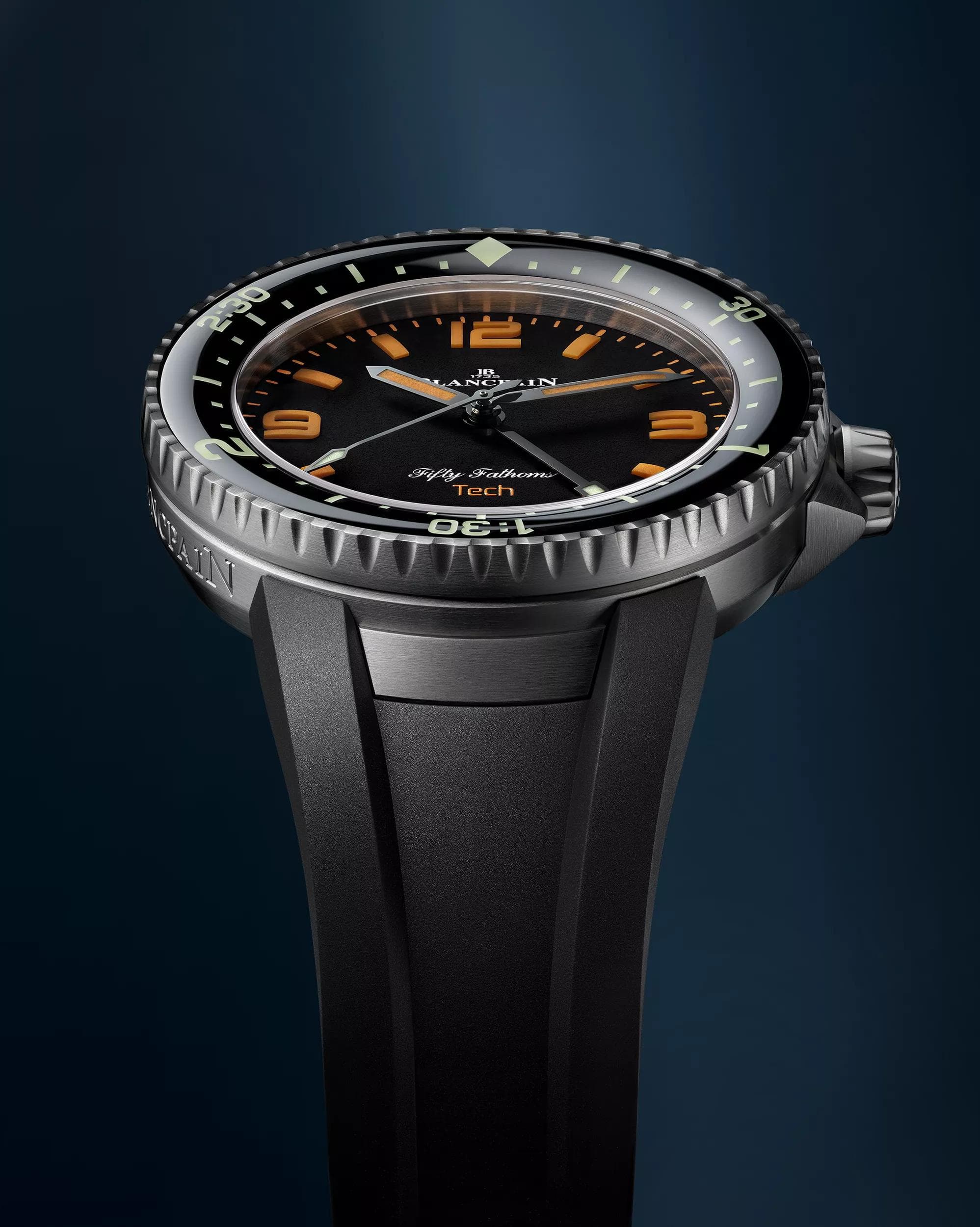
Which ref to buy
The Fifty Fathoms has the strongest historical claim of any production dive watch -- predating the Submariner by a year in 1953 and written into US Navy and French combat diver specifications. Cal. 1315 and the 45mm automatique are the reference against which everything in the family is measured.
- 1Open
The genuine article: 45mm Fifty Fathoms Automatique with cal. 1315, 120-hour power reserve, and milspec heritage.
- The case for it:
- Cal. 1315 with 120-hour power reserve is genuinely useful. The 45mm case is large but historically correct. This is the watch with the unbroken lineage to the 1953 original and the specifications that went into French Navy combat diving.
- Consider instead if:
- At 45mm it is not a subtle watch. If wearability is the priority, the Bathyscaphe at 43mm gives you nearly identical specs in a more practical case.
- 2Open
43mm Bathyscaphe with the same movement quality as the Automatique and a black ceramic bezel -- more wearable case, zero-maintenance bezel performance.
- The case for it:
- Cal. 1315 with the full Fifty Fathoms specification in a 43mm case. Black ceramic bezel resists fading and scratching in ways aluminum cannot. The daily driver configuration for buyers who want the movement without the 45mm Automatique's heftier presence.
- Consider instead if:
- Purists consider the Automatique the correct Fifty Fathoms, and the ceramic bezel changes the character of the watch relative to the steel-bezel original. If collector resale matters, the Automatique holds stronger demand.
- 3Open
Aqua Lung collaboration edition with niche provenance -- limited production and specific collector appeal.
- The case for it:
- The Aqua Lung collaboration references a genuine chapter of diving history. Limited production and the provenance story create collector interest that the standard refs do not have.
- Consider instead if:
- The collaboration premium is paid for a story rather than a mechanical difference. The Automatique is the better watch for the money without the provenance uplift.
Rankings last reviewed 2026-06-06. Editorial perspective only. Not financial advice.