
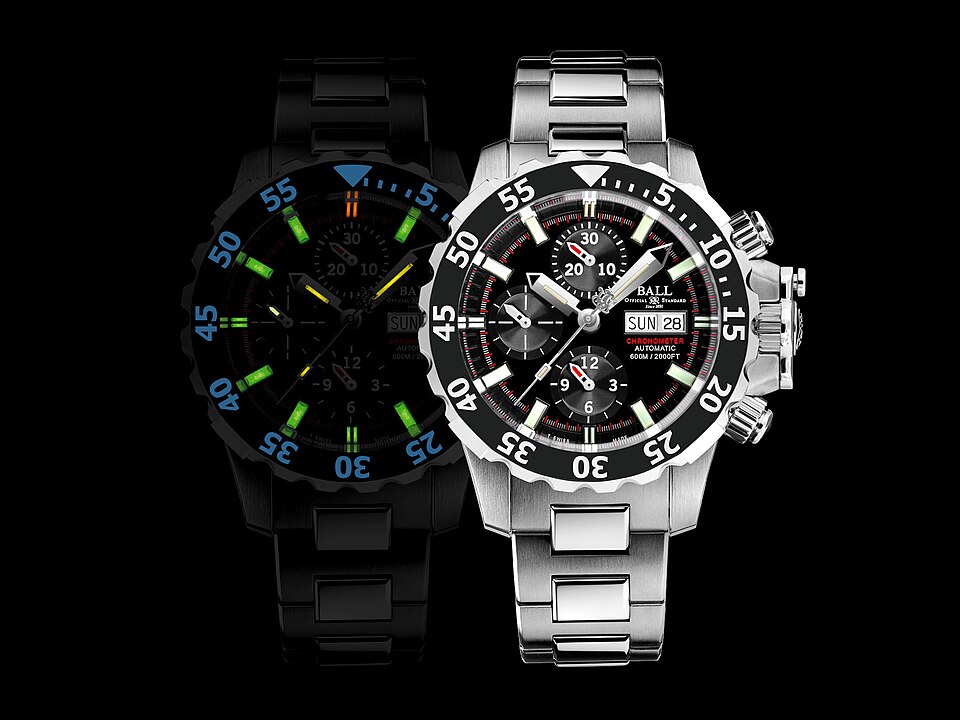
The Ball Watch Engineer Hydrocarbon | family history
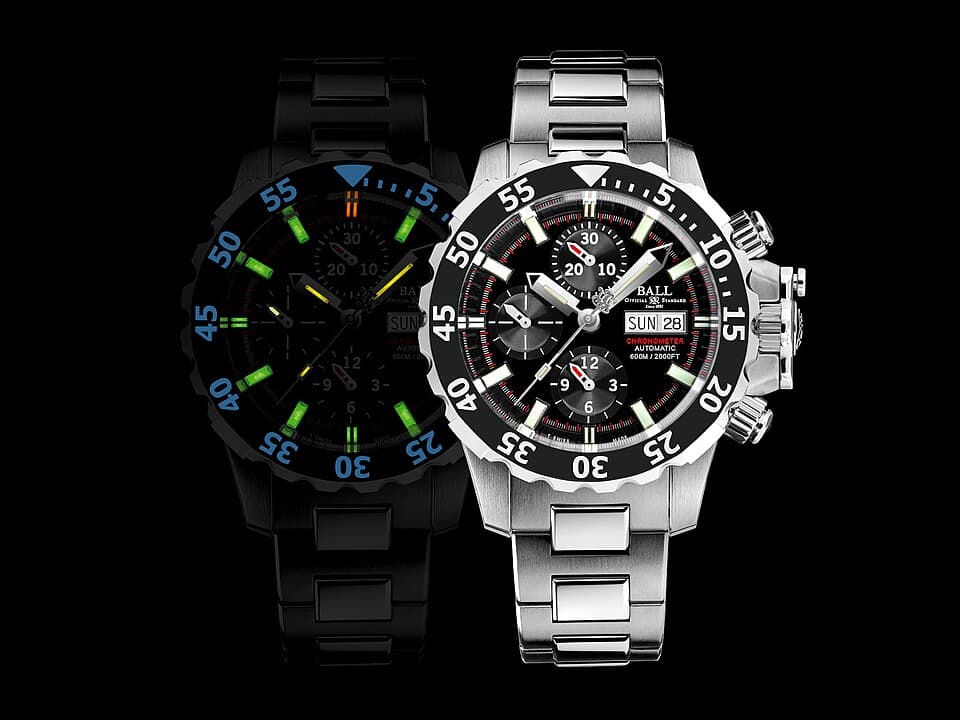
The Engineer Hydrocarbon is Ball Watch's professional dive brief: the Nedu at 300m with a helium escape valve, and the Deep Quest at 600m. Both use titanium cases with Ball's micro gas tube illumination system. The Nedu is named for the US Navy Experimental Diving Unit; it carries the professional-specification brief the Engineer III does not.
Ball Watch's professional-diver and extreme-environment sub-line within the Engineer family. Cases are rated from 200 m to 3,000 m depending on the variant; all carry tritium micro-gas tubes for lume independence in the dark. The Nedu (2020) uses the in-house RR1102 COSC movement with a bi-directional ceramic bezel and 300 m rating at a price that undercuts Swiss diver competitors by a significant margin.
2002 · Hydrocarbon launch
Ball Watch launched the Engineer Hydrocarbon line in 2002 as the brand's explicit professional-diving statement. The name referenced the hydrocarbon-rich deep-sea environments that saturation divers work in. Early Hydrocarbon references established the titanium case architecture and helium escape valve brief that the line has maintained.
No references from this era in the catalog yet.
2010-present · Nedu and current Hydrocarbon line
The Hydrocarbon Nedu (named for the Navy Experimental Diving Unit) is the current professional-specification reference: 300m WR, titanium, helium escape valve, and Ball's tritium micro gas tube system. The Deep Quest pushes to 600m in the same material and illumination system. Both use ETA or Ball-caliber base movements.
How to read this family
Two honest questions for any Hydrocarbon buyer:
- Hydrocarbon Nedu or Engineer III for a serious diver? The Nedu is the more specified choice: 300m, titanium, helium escape valve. The Engineer III Maverick is 300m but without the helium escape valve and typically in steel. For saturation diving use, the Nedu is the correct choice. For recreational diving, either works; the Nedu justifies its higher price only if the helium escape valve is operationally relevant.
- Ball Hydrocarbon vs. Oris ProDiver at this spec level? The Oris ProDiver Chronograph is larger (51mm) and adds a mechanical chronograph to the 500m brief. The Ball Hydrocarbon Nedu is smaller and focused on the dive function without chronograph complexity. For a working diver who wants the simplest possible high-specification tool, the Nedu. For a collector who wants the full professional-diver mechanical chronograph package, the Oris.
Related families: Ball Engineer III · Oris ProDiver
References in this family
Which ref to buy
The Engineer Hydrocarbon line is Ball's deep dive and professional instrument proposition, with tritium gas tube illumination that requires no power source, 300m water resistance, and anti-shock construction. Ball's tritium tube lighting system is patented and genuinely superior to luminous paint in operational conditions.
- 1Open
Engineer Hydrocarbon NEDU: 300m, COSC-certified ETA movement, 21 tritium gas tubes, helium escape valve.
- The case for it:
- The NEDU (Naval Experimental Diving Unit spec) is Ball's most serious diver. COSC-certified movement, 300m rating, and more tritium tubes than any comparable watch. For buyers who want dive watch illumination that actually works in darkness rather than fading after 8 hours, this is functionally superior to anything relying solely on luminous paint.
- Consider instead if:
- Brand recognition outside the tool-watch community is limited. Secondary market value is modest. Buyers who want a 300m diver with better collector culture should consider the Omega Seamaster 300m or Tudor Pelagos.
Rankings last reviewed 2026-06-18. Editorial perspective only. Not financial advice.